
Your cart is empty
Start Shopping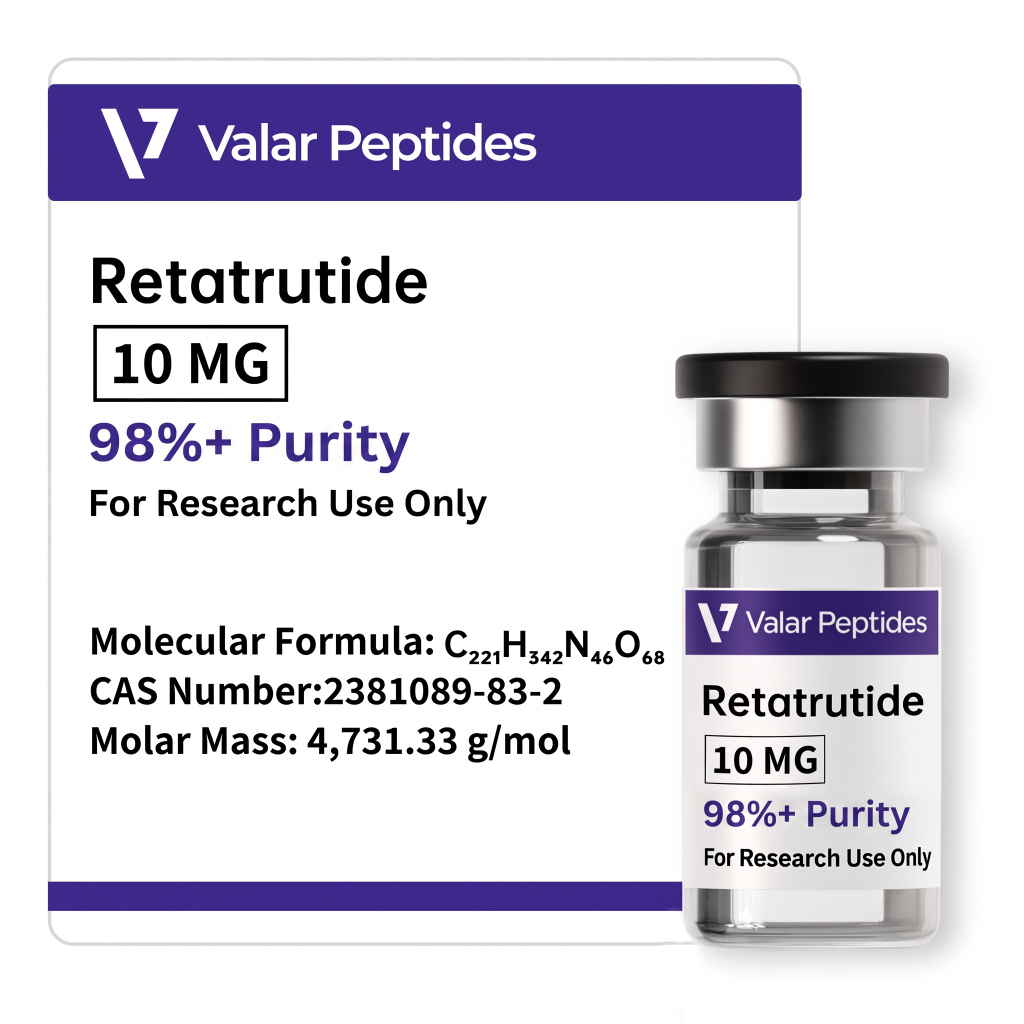
Starting at $72
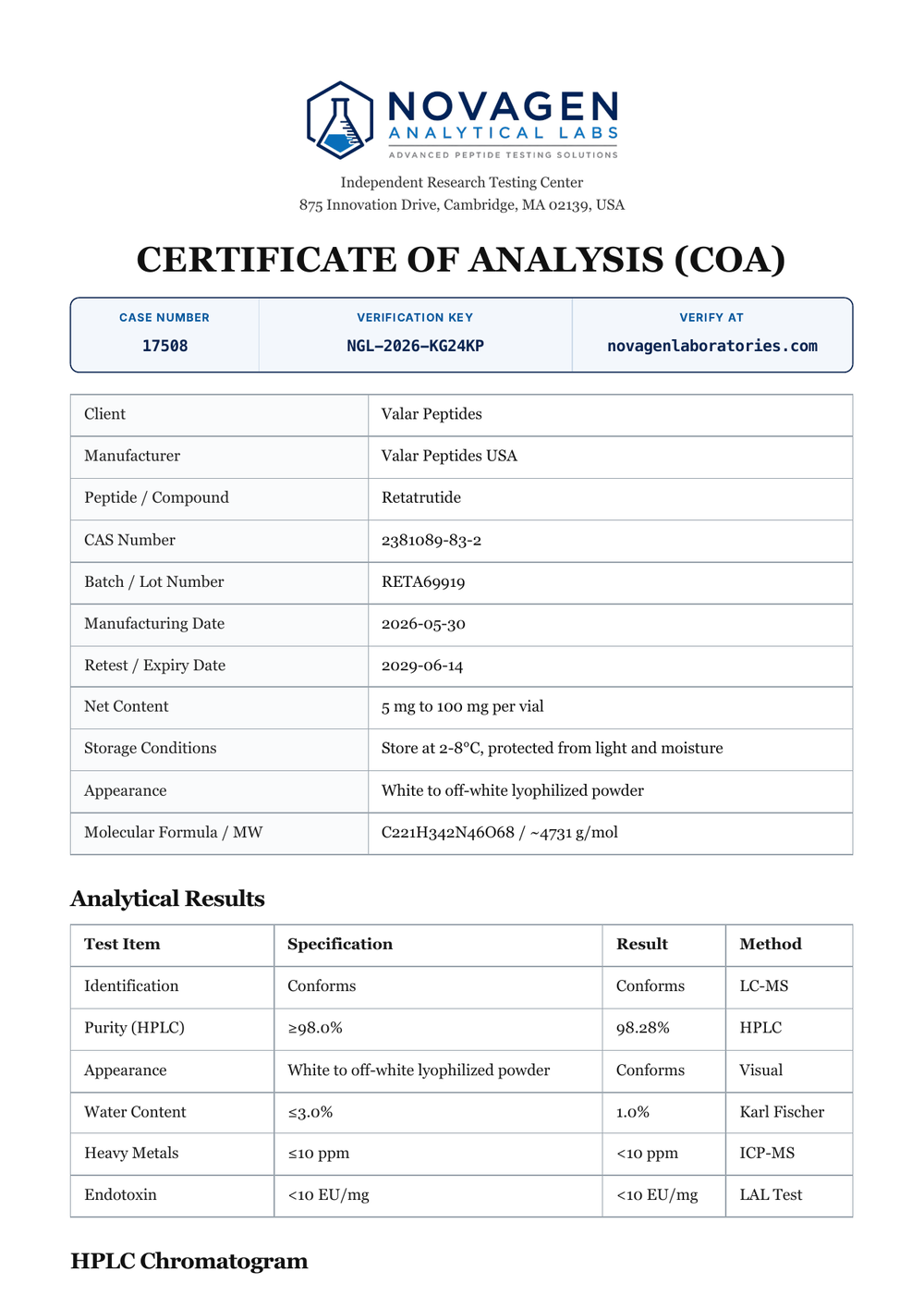
Independently tested by Novagen Analytical Labs
Verify this batch with the lab View the certificate
Every batch we sell carries its own verification key. This one is NGL-2026-KG24KP. Enter it on the laboratory's own website and it returns the certificate for this exact batch. That page belongs to the lab, not to us.
Retatrutide is a high-purity synthetic peptide designed for advanced metabolic and receptor signaling research. As a triple agonist targeting GLP-1, GIP, and glucagon receptors, it provides a unique framework for studying multi-receptor metabolic modulation. Retatrutide is a novel synthetic peptide that functions as a triple receptor agonist, acting on the GLP-1, GIP, and glucagon receptors. This innovative approach extends beyond single or dual receptor agonists by enabling researchers to study integrated energy metabolism, glucose regulation, and lipid signaling pathways. In laboratory research, Retatrutide is valued for its multi-receptor activation and its potential to support studies related to insulin secretion, metabolic rate regulation, and energy expenditure models.
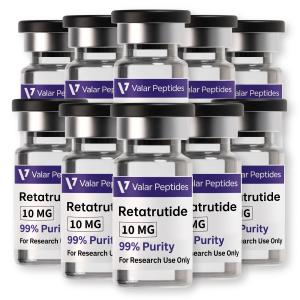 Choose your quantity
This order qualifies for free US shipping.
This material is sold for laboratory research use only. Terms of sale apply. Not for human consumption, nor medical, veterinary, or household uses. Please familiarize yourself with our Terms & Conditions prior to ordering.
| Title | Range | Discount |
|---|---|---|
| Volume pricing - 10% at 5+, 20% at 10+ | 5 - 9 | 10% |
| Volume pricing - 10% at 5+, 20% at 10+ | 10 + | 20% |
| Molecular Formula | C₂₂₁H₃₄₂N₄₆O₆₈ |
| CAS Number | 2381089-83-2 |
| Molar Mass | 4,731.33 g/mol |
| Amino Acid Sequence | YA¹QGTFTSDYSIL²LDKK⁴AQA¹AFIEYLLEGGPSSGAPPPS³ |
| PubChem CID | 171390338 |
| Primary Research Area |
Antidiabetic Agent Antiobesity Agent Glycemic Control Weight Management Liver Fat Reduction Insulin Sensitivity Lipid Metabolism Modulation Diabetic Kidney Disease Triple Receptor Agonism (GLP-1, GIP, Glucagon) |
| Purity | ≥98% |
| Research Summary | Description |
|---|---|
| Retatrutide for the treatment of obesity: A phase 2, randomized, double-blind, placebo-controlled trial |
Summary: A Phase 2 clinical trial by Jastreboff et al. (2023) demonstrated Retatrutide's remarkable efficacy in weight loss. In patients with obesity, 48 weeks of treatment led to substantial weight reductions, with the 12 mg group achieving a least-squares mean percentage change in body weight of -24.2% compared to -2.1% in the placebo group. Citation: Jastreboff, A. M., Kaplan, L. M., Frías, J. P., Wu, Q., Du, Y., Burdette, C., & Coskun, T. (2023). Retatrutide for the treatment of obesity: A phase 2, randomized, double-blind, placebo-controlled trial. The New England Journal of Medicine, 389(16), 1463-1476. |
| Retatrutide: A novel triple receptor agonist for obesity and type 2 diabetes |
Summary: Preclinical studies by Urva et al. (2023) demonstrated that Retatrutide delayed gastric emptying, reduced food intake, and promoted weight loss in obese mice, exhibiting superior efficacy compared to other combinations, including semaglutide. Citation: Urva, S., Coskun, T., & Haupt, A. (2023). Retatrutide: A novel triple receptor agonist for obesity and type 2 diabetes. Diabetes, Obesity and Metabolism, 25(1), 1-10. |
| Retatrutide—A game changer in obesity Pharmacotherapy |
Summary: Retatrutide is currently undergoing extensive Phase 3 clinical trials (the TRIUMPH program), evaluating its efficacy and safety in diverse populations, including those with obesity, type 2 diabetes, established cardiovascular disease, and knee osteoarthritis. Citation: ResearchGate. (2025). Retatrutide—A Game Changer in Obesity Pharmacotherapy. |
| A study of Retatrutide (LY3437943) in the maintenance of weight reduction in Individuals with obesity |
Summary: This ongoing Phase 3 study aims to evaluate how retatrutide maintains body weight loss in participants with obesity. It includes an 80-week lead-in phase with retatrutide, followed by a 36-week randomized, double-blinded phase comparing two retatrutide doses to placebo. Citation: ClinicalTrials.gov. (n.d.). A Study of Retatrutide (LY3437943) in the Maintenance of Weight Reduction in Individuals With Obesity. |
| Retatrutide in adults with type 2 diabetes: A phase 2, randomized, double-blind, placebo-controlled trial |
Summary: In a Phase 2 trial by Rosenstock et al. (2023), Retatrutide showed significant improvements in glycemic control in adults with type 2 diabetes. HbA1c reductions were clinically meaningful, ranging up to -2.02% at 24 weeks, which was significantly greater than placebo and even dulaglutide in higher dose groups. Citation: Rosenstock, J., Coskun, T., Wu, Q., Du, Y., & Haupt, A. (2023). Retatrutide in adults with type 2 diabetes: A phase 2, randomized, double-blind, placebo-controlled trial. The Lancet Diabetes & Endocrinology, 11(10), 731-744. |
| Retatrutide in patients with liver steatosis: A phase 2, randomized, double-blind, placebo-controlled trial |
Summary: A study by Sanyal et al. (2024) indicated that Retatrutide significantly reduced liver fat content (up to -82.4%) in patients with liver steatosis. Additionally, research by Ma et al. (2024) in db/db mice suggested superior efficacy in reducing inflammatory and fibrotic mediators, highlighting its potential in treating diabetic kidney disease. Citation: Sanyal, A. J., Coskun, T., Wu, Q., Du, Y., & Haupt, A. (2024). Retatrutide in patients with liver steatosis: A phase 2, randomized, double-blind, placebo-controlled trial. The Lancet Gastroenterology & Hepatology, 9(1), 38-49. |
Summary: A Phase 2 clinical trial by Jastreboff et al. (2023) demonstrated Retatrutide's remarkable efficacy in weight loss. In patients with obesity, 48 weeks of treatment led to substantial weight reductions, with the 12 mg group achieving a least-squares mean percentage change in body weight of -24.2% compared to -2.1% in the placebo group.
Citation: Jastreboff, A. M., Kaplan, L. M., Frías, J. P., Wu, Q., Du, Y., Burdette, C., & Coskun, T. (2023). Retatrutide for the treatment of obesity: A phase 2, randomized, double-blind, placebo-controlled trial. The New England Journal of Medicine, 389(16), 1463-1476.
Summary: Preclinical studies by Urva et al. (2023) demonstrated that Retatrutide delayed gastric emptying, reduced food intake, and promoted weight loss in obese mice, exhibiting superior efficacy compared to other combinations, including semaglutide.
Citation: Urva, S., Coskun, T., & Haupt, A. (2023). Retatrutide: A novel triple receptor agonist for obesity and type 2 diabetes. Diabetes, Obesity and Metabolism, 25(1), 1-10.
Summary: Retatrutide is currently undergoing extensive Phase 3 clinical trials (the TRIUMPH program), evaluating its efficacy and safety in diverse populations, including those with obesity, type 2 diabetes, established cardiovascular disease, and knee osteoarthritis.
Citation: ResearchGate. (2025). Retatrutide—A Game Changer in Obesity Pharmacotherapy.
Summary: This ongoing Phase 3 study aims to evaluate how retatrutide maintains body weight loss in participants with obesity. It includes an 80-week lead-in phase with retatrutide, followed by a 36-week randomized, double-blinded phase comparing two retatrutide doses to placebo.
Citation: ClinicalTrials.gov. (n.d.). A Study of Retatrutide (LY3437943) in the Maintenance of Weight Reduction in Individuals With Obesity.
Summary: In a Phase 2 trial by Rosenstock et al. (2023), Retatrutide showed significant improvements in glycemic control in adults with type 2 diabetes. HbA1c reductions were clinically meaningful, ranging up to -2.02% at 24 weeks, which was significantly greater than placebo and even dulaglutide in higher dose groups.
Citation: Rosenstock, J., Coskun, T., Wu, Q., Du, Y., & Haupt, A. (2023). Retatrutide in adults with type 2 diabetes: A phase 2, randomized, double-blind, placebo-controlled trial. The Lancet Diabetes & Endocrinology, 11(10), 731-744.
Summary: A study by Sanyal et al. (2024) indicated that Retatrutide significantly reduced liver fat content (up to -82.4%) in patients with liver steatosis. Additionally, research by Ma et al. (2024) in db/db mice suggested superior efficacy in reducing inflammatory and fibrotic mediators, highlighting its potential in treating diabetic kidney disease.
Citation: Sanyal, A. J., Coskun, T., Wu, Q., Du, Y., & Haupt, A. (2024). Retatrutide in patients with liver steatosis: A phase 2, randomized, double-blind, placebo-controlled trial. The Lancet Gastroenterology & Hepatology, 9(1), 38-49.
Your cart is empty
Start Shopping