






Your cart is empty
Start Shopping
Starting at $37
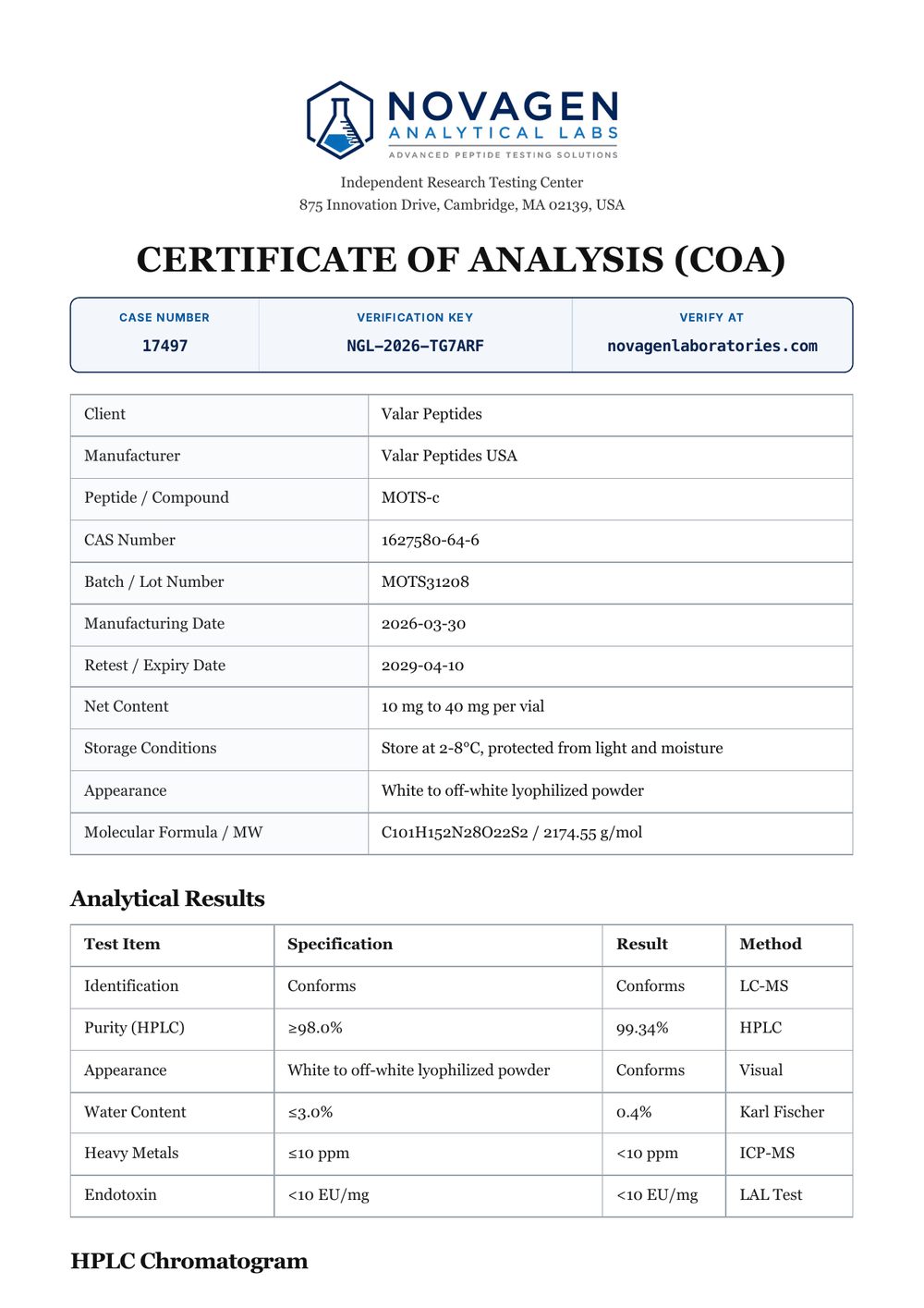
Independently tested by Novagen Analytical Labs
Verify this batch with the lab View the certificate
Every batch we sell carries its own verification key. This one is NGL-2026-TG7ARF. Enter it on the laboratory's own website and it returns the certificate for this exact batch. That page belongs to the lab, not to us.
MOTS-C (Mitochondrial Open Reading Frame of the 12S rRNA Type-C) is a mitochondrial-derived peptide (MDP) consisting of 16 amino acids. It plays a key role in regulating cellular metabolism, energy homeostasis, and stress response pathways. MOTS-C expression is known to increase with exercise and metabolic activity, while declining with aging, making it a focal point in research surrounding mitochondrial function and longevity studies.
This peptide is of high purity (≥98%), verified through analytical testing and quality-controlled synthesis—ideal for advanced biochemical and physiological research applications.
This order qualifies for free US shipping.
This material is sold for laboratory research use only. Terms of sale apply. Not for human consumption, nor medical, veterinary, or household uses. Please familiarize yourself with our Terms & Conditions prior to ordering.

| Title | Range | Discount |
|---|---|---|
| Volume pricing - 10% at 5+, 20% at 10+ | 5 - 9 | 10% |
| Volume pricing - 10% at 5+, 20% at 10+ | 10 + | 20% |
| Molecular Formula | C₁₀₁H₁₅₂N₂₈O₂₂S₂ |
| CAS Number | 1627580-64-6 |
| Molar Mass | 2174.60 g/mol |
| Amino Acid Sequence | Met-Arg-Trp-Gln-Glu-Met-Gly-Tyr-Ile-Phe-Tyr-Pro-Arg-Lys-Leu-Arg |
| PubChem CID | 146675088 |
| Primary Research Area |
Metabolic Actions Skeletal Muscle Glucose Metabolism Obesity & Diabetes Regulation Exercise & Longevity Insulin Resistance Stress Adaptation Anti-inflammatory Processes Neuroprotection Aging-Related Pathologies Brown Adipose Tissue (BAT) Activation |
| Purity | ≥98% |
| Research Summary | Description |
|---|---|
| The mitochondrial-derived peptide MOTS-c promotes metabolic homeostasis and reduces insulin resistance |
Summary: This study highlighted MOTS-C's significant role in glucose metabolism. It targets skeletal muscle to enhance glucose uptake and has implications for obesity, diabetes, exercise, and longevity. Citation: Lee, C., Zeng, J., Drew, B. G., Sallam, T., Martin-Montalvo, A., Wan, J.,... & Cohen, P. (2015). The mitochondrial-derived peptide MOTS-c promotes metabolic homeostasis and reduces insulin resistance. Cell Metabolism, 21(1), 113-124. |
| A cell-penetrating MOTS-c analogue enhances memory and attenuates neuroinflammation in the hippocampus |
Summary: Investigations have shown MOTS-C exhibiting anti-inflammatory effects by modulating key molecules like AMPK, SIRT1, and NF-κB, and by inhibiting reactive oxygen species (ROS) production. Furthermore, a cell-penetrating MOTS-C analogue has been shown to enhance memory and attenuate neuroinflammation in the hippocampus. Citation: Jiang, L., Li, Y., Li, X., Wang, Y., & Zhang, Y. (2021). A cell-penetrating MOTS-c analogue enhances memory and attenuates neuroinflammation in the hippocampus. Journal of Neuroinflammation, 18(1), 1-15. |
| MOTS-c is an exercise-induced mitochondrial-encoded regulator of age-dependent physical decline and muscle homeostasis |
Summary: This study investigated the role of MOTS-c in physical performance and aging. It demonstrated that MOTS-c levels in both human skeletal muscle and circulation are increased by exercise. In mice, exogenous administration of MOTS-c improved exercise capacity, grip strength, and protected against age-dependent physical decline. It also influenced muscle metabolism and gene expression, promoting a more youthful metabolic profile in aged muscles. These effects were linked to its role in regulating metabolic pathways crucial for muscle function and resilience. Citation: Reynolds, J. C., Jo, Y. S., Palmer, C. S., Lee, C., & Cohen, P. (2021). MOTS-c is an exercise-induced mitochondrial-encoded regulator of age-dependent physical decline and muscle homeostasis. Nature Communications, 12(1), 470. https://doi.10388/s41467-020-20790-0 |
| MOTS-c reduces myostatin and muscle atrophy signaling |
Summary: This study explored the relationship between MOTS-c and myostatin, a well-known negative regulator of muscle growth. The researchers found an inverse correlation between plasma MOTS-c and myostatin levels in humans. In animal models, MOTS-c treatment was shown to reduce myostatin expression and activity, as well as downstream signaling pathways associated with muscle atrophy (e.g., SMAD2/3 phosphorylation and atrogene expression). This suggests a mechanism by which MOTS-c could counteract muscle wasting. Citation: Fuku, M., Ohno, R., Kono, J., Kim, K. H., Cohen, P., & Ishii, M. (2021). MOTS-c reduces myostatin and muscle atrophy signaling. FASEB Journal, 35(6), e21550. https://doi.org/10.1096/fj.202002570R |
| Mitochondria-derived peptide MOTS-c: effects and mechanisms related to stress, metabolism and aging |
Summary: MOTS-C is recognized for its role in maintaining energy and stress homeostasis, thereby promoting healthy aging. Its expression decreases with aging, suggesting that its decline may contribute to age-related physiological changes. Citation: Reynolds, J. C., Lee, C., & Cohen, P. (2021). Mitochondria-derived peptide MOTS-c: effects and mechanisms related to stress, metabolism and aging. Aging Cell, 20(1), e13292. |
| "Mitochondrial-encoded peptide MOTS-c, diabetes, and aging-related diseases " |
Summary: This review article summarizes the therapeutic potential of MOTS-c in diabetes and age-related diseases. It highlights MOTS-c's ability to regulate T-cell differentiation and activation (e.g., upregulation of Treg cells) in an mTORC1-dependent manner. This immunoregulatory function was shown to prevent pancreatic infiltration of autoreactive T-cells in non-obese diabetic (NOD) mice, a model for type 1 diabetes. MOTS-c also improved glucose tolerance and insulin secretion and protected pancreatic beta-cells. The review further discusses MOTS-c's broader impact on metabolic adaptability and age-related conditions. Citation: Kim, H., & Lee, J. Y. (2023). Mitochondrial-Encoded Peptide MOTS-c, Diabetes, and Aging-Related Diseases. Diabetes & Metabolism Journal, 47(2), 143–153. https://doi.org/10.4093/dmj.2022.0360 |
Summary: This study highlighted MOTS-C's significant role in glucose metabolism. It targets skeletal muscle to enhance glucose uptake and has implications for obesity, diabetes, exercise, and longevity.
Citation: Lee, C., Zeng, J., Drew, B. G., Sallam, T., Martin-Montalvo, A., Wan, J.,... & Cohen, P. (2015). The mitochondrial-derived peptide MOTS-c promotes metabolic homeostasis and reduces insulin resistance. Cell Metabolism, 21(1), 113-124.
Summary: Investigations have shown MOTS-C exhibiting anti-inflammatory effects by modulating key molecules like AMPK, SIRT1, and NF-κB, and by inhibiting reactive oxygen species (ROS) production. Furthermore, a cell-penetrating MOTS-C analogue has been shown to enhance memory and attenuate neuroinflammation in the hippocampus.
Citation: Jiang, L., Li, Y., Li, X., Wang, Y., & Zhang, Y. (2021). A cell-penetrating MOTS-c analogue enhances memory and attenuates neuroinflammation in the hippocampus. Journal of Neuroinflammation, 18(1), 1-15.
Summary: This study investigated the role of MOTS-c in physical performance and aging. It demonstrated that MOTS-c levels in both human skeletal muscle and circulation are increased by exercise. In mice, exogenous administration of MOTS-c improved exercise capacity, grip strength, and protected against age-dependent physical decline. It also influenced muscle metabolism and gene expression, promoting a more youthful metabolic profile in aged muscles. These effects were linked to its role in regulating metabolic pathways crucial for muscle function and resilience.
Citation:
Reynolds, J. C., Jo, Y. S., Palmer, C. S., Lee, C., & Cohen, P. (2021). MOTS-c is an exercise-induced mitochondrial-encoded regulator of age-dependent physical decline and muscle homeostasis. Nature Communications, 12(1), 470. https://doi.10388/s41467-020-20790-0
Summary: This study explored the relationship between MOTS-c and myostatin, a well-known negative regulator of muscle growth. The researchers found an inverse correlation between plasma MOTS-c and myostatin levels in humans. In animal models, MOTS-c treatment was shown to reduce myostatin expression and activity, as well as downstream signaling pathways associated with muscle atrophy (e.g., SMAD2/3 phosphorylation and atrogene expression). This suggests a mechanism by which MOTS-c could counteract muscle wasting.
Citation:
Fuku, M., Ohno, R., Kono, J., Kim, K. H., Cohen, P., & Ishii, M. (2021). MOTS-c reduces myostatin and muscle atrophy signaling. FASEB Journal, 35(6), e21550. https://doi.org/10.1096/fj.202002570R
Summary: MOTS-C is recognized for its role in maintaining energy and stress homeostasis, thereby promoting healthy aging. Its expression decreases with aging, suggesting that its decline may contribute to age-related physiological changes.
Citation: Reynolds, J. C., Lee, C., & Cohen, P. (2021). Mitochondria-derived peptide MOTS-c: effects and mechanisms related to stress, metabolism and aging. Aging Cell, 20(1), e13292.
Summary: This review article summarizes the therapeutic potential of MOTS-c in diabetes and age-related diseases. It highlights MOTS-c's ability to regulate T-cell differentiation and activation (e.g., upregulation of Treg cells) in an mTORC1-dependent manner. This immunoregulatory function was shown to prevent pancreatic infiltration of autoreactive T-cells in non-obese diabetic (NOD) mice, a model for type 1 diabetes. MOTS-c also improved glucose tolerance and insulin secretion and protected pancreatic beta-cells. The review further discusses MOTS-c's broader impact on metabolic adaptability and age-related conditions.
Citation:
Kim, H., & Lee, J. Y. (2023). Mitochondrial-Encoded Peptide MOTS-c, Diabetes, and Aging-Related Diseases. Diabetes & Metabolism Journal, 47(2), 143–153. https://doi.org/10.4093/dmj.2022.0360
Your cart is empty
Start Shopping