
Your cart is empty
Start Shopping
Starting at $61
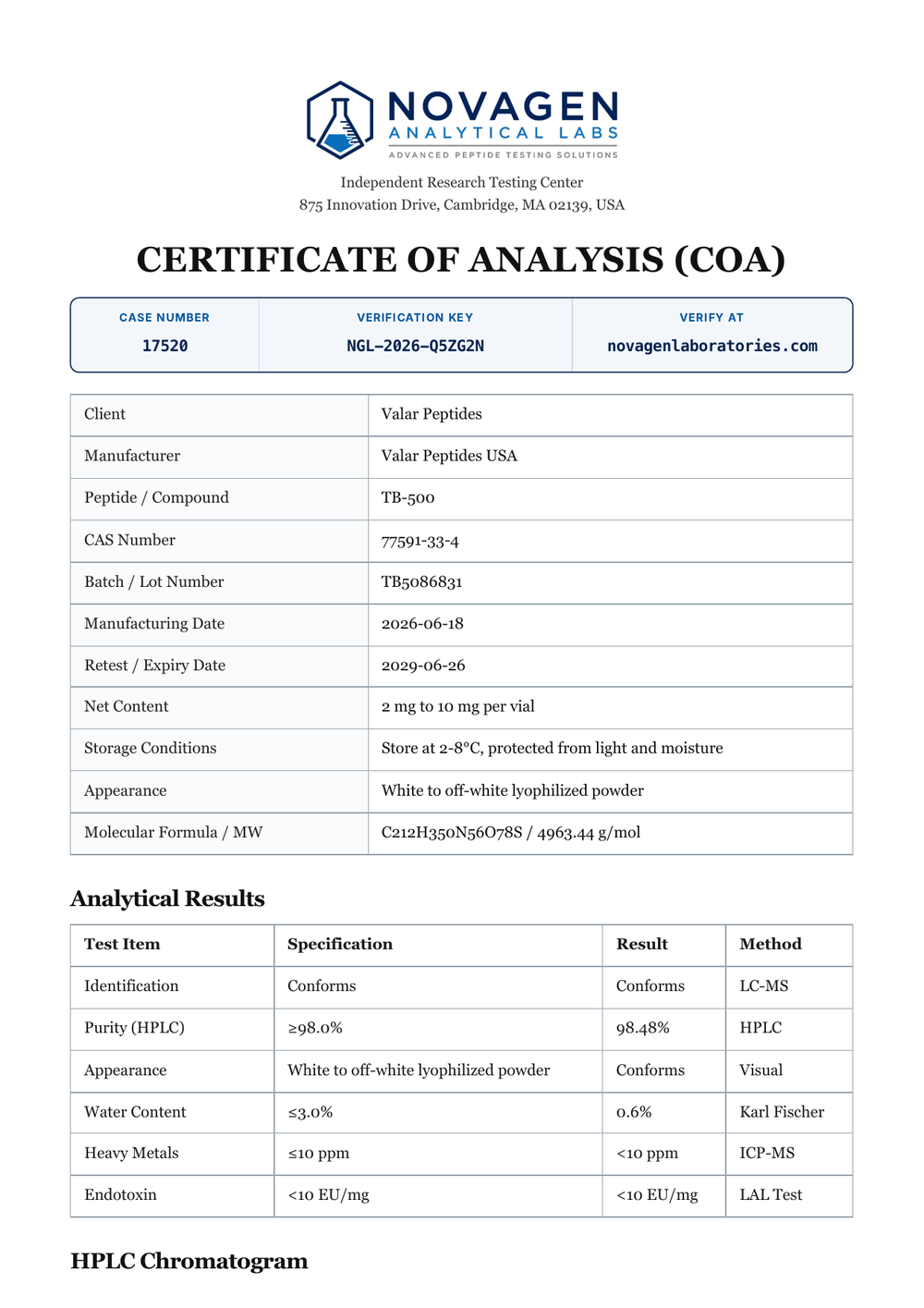
Independently tested by Novagen Analytical Labs
Verify this batch with the lab View the certificate
Every batch we sell carries its own verification key. This one is NGL-2026-Q5ZG2N. Enter it on the laboratory's own website and it returns the certificate for this exact batch. That page belongs to the lab, not to us.
TB-500 (Thymosin Beta-4) is a synthetic research peptide modeled after a naturally occurring protein present in most mammalian cells. It has been widely studied for its role in tissue regeneration, wound healing, and inflammation response.
In research settings, TB-500 has been observed to promote cell migration, angiogenesis (formation of new blood vessels), and tissue remodeling, processes that are essential in cellular repair studies. These findings have made it an important focus in regenerative and recovery-based peptide research.
This order qualifies for free US shipping.
This material is sold for laboratory research use only. Terms of sale apply. Not for human consumption, nor medical, veterinary, or household uses. Please familiarize yourself with our Terms & Conditions prior to ordering.
| Title | Range | Discount |
|---|---|---|
| Volume pricing - 10% at 5+, 20% at 10+ | 5 - 9 | 10% |
| Volume pricing - 10% at 5+, 20% at 10+ | 10 + | 20% |
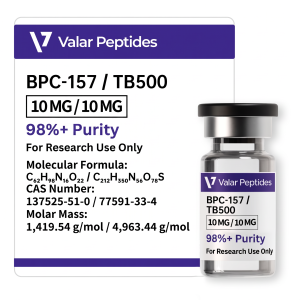
| Molecular Formula | C₂₁₂H₃₅₀N₅₆O₇₈S |
| CAS Number | 77591‑33‑4 |
| Molar Mass | 4,963.44 g/mol |
| Amino Acid Sequence | Ac-Ser-Asp-Lys-Pro-Asp-Met-Ala-Glu-Ile-Glu-Lys-Phe-Asp-Lys-Ser-Lys-Leu-Lys-Lys-Thr-Glu-Thr-Gln-Glu-Lys-Asn-Pro-Leu-Pro-Ser-Lys-Glu-Thr-Ile-Glu-Gln-Glu-Lys-Gln-Ala-Gly-Glu-Ser |
| PubChem CID | 16132341 |
| Primary Research Area |
Healing & Recovery Tissue Repair & Remodeling Anti-inflammatory Effects Angiogenesis (New Blood Vessel Formation) Cell Migration Stem Cell Differentiation Muscle Tissue Repair Heart Muscle Regeneration Soft Tissue Regeneration (Joint Pain, Tendons, Ligaments, Cartilage) Anti-aging Properties |
| Purity | ≥98% |
| Research Summary | Description |
|---|---|
| Utilizing developmentally essential secreted peptides such as Thymosin Beta-4 to remind the adult organs of their embryonic state—new directions in anti-aging regenerative therapies |
Summary: Studies involving laboratory rats showed that administration of Tβ4 (from which TB500 is derived) led to faster healing, thicker and longer collagen fiber bundles, and less scarring in wounds. Citation: Maar, K., Maar, M., & Maar, T. (2024). Utilizing Developmentally Essential Secreted Peptides Such as Thymosin Beta-4 to Remind the Adult Organs of Their Embryonic State—New Directions in Anti-Aging Regenerative Therapies. Cells, 13(1), 85. |
| Thymosin Beta-4 (TB-500) is a peptide that has gained attention in recent years for its potential to promote healing and tissue repair. |
Summary: TB500, like its parent Tβ4, possesses anti-inflammatory capabilities. It helps reduce swelling, redness, and pain associated with injuries by controlling the inflammatory response. Citation: Siam Clinic Thailand. (n.d.). Thymosin Beta-4 (TB-500) is a peptide that has gained attention in recent years for its potential to promote healing and tissue repair. |
| Local and systemic peptide therapies for soft tissue regeneration: a narrative review |
Summary: This review identified various peptides, including those related to TB500, demonstrating efficacy in soft tissue repair. It noted that oral and intra-articular peptides showed distinct advantages in soft tissue regeneration, with intra-articular routes providing localized effects and oral routes offering systemic benefits. Citation: Canapp Jr, S. O., Leasure, C. S., & Canapp, D. A. (2024). Local and Systemic Peptide Therapies for Soft Tissue Regeneration: A Narrative Review. Cells, 13(18), 1545. |
| Thymosin beta 4 and cardiac repair |
Summary: This study explores the role of Thymosin Beta-4 (Tβ4) in cardiac repair, particularly after myocardial infarction (heart attack). It highlights Tβ4's ability to inhibit myocardial cell death, stimulate new blood vessel growth (angiogenesis), and activate endogenous cardiac progenitor cells, effectively ""reminding"" the adult heart of its embryonic program. The study suggests that Tβ4 can initiate simultaneous myocardial and vascular regeneration after systemic administration in vivo. Citation: Shrivastava, S., Srivastava, D., Olson, E. N., DiMaio, J. M., & Bock-Marquette, I. (2010). Thymosin beta 4 and cardiac repair. Annals of the New York Academy of Sciences, 1194(1), 87–96. https://doi.org/10.1111/j.1749-6632.2010.05468.x |
| Neuroprotective and neurorestorative effects of Thymosin beta 4 treatment following experimental traumatic brain injury |
Summary: This preclinical study investigated the therapeutic potential of Thymosin Beta-4 (Tβ4) in a rat model of traumatic brain injury (TBI). The findings indicated that Tβ4 treatment significantly improved neurological severity scores and reduced the incidence of motor deficits in TBI rats. Histological data showed that early Tβ4 treatment reduced cortical lesion volume and hippocampal cell loss. These results suggest that Tβ4 provides neuroprotection and neurorestoration, even when administered hours after the injury. Citation: Wang, Y., Lu, Y., & Li, J. (2012). Neuroprotective and neurorestorative effects of Thymosin beta 4 treatment following experimental traumatic brain injury. Neural Regeneration Research, 7(34), 2686–2693. https://doi.org/10.3969/j.issn.1673-5374.2012.34.004 |
Summary: Studies involving laboratory rats showed that administration of Tβ4 (from which TB500 is derived) led to faster healing, thicker and longer collagen fiber bundles, and less scarring in wounds.
Citation: Maar, K., Maar, M., & Maar, T. (2024). Utilizing Developmentally Essential Secreted Peptides Such as Thymosin Beta-4 to Remind the Adult Organs of Their Embryonic State—New Directions in Anti-Aging Regenerative Therapies. Cells, 13(1), 85.
Summary: TB500, like its parent Tβ4, possesses anti-inflammatory capabilities. It helps reduce swelling, redness, and pain associated with injuries by controlling the inflammatory response.
Citation: Siam Clinic Thailand. (n.d.). Thymosin Beta-4 (TB-500) is a peptide that has gained attention in recent years for its potential to promote healing and tissue repair.
Summary: This review identified various peptides, including those related to TB500, demonstrating efficacy in soft tissue repair. It noted that oral and intra-articular peptides showed distinct advantages in soft tissue regeneration, with intra-articular routes providing localized effects and oral routes offering systemic benefits.
Citation: Canapp Jr, S. O., Leasure, C. S., & Canapp, D. A. (2024). Local and Systemic Peptide Therapies for Soft Tissue Regeneration: A Narrative Review. Cells, 13(18), 1545.
Summary: This study explores the role of Thymosin Beta-4 (Tβ4) in cardiac repair, particularly after myocardial infarction (heart attack). It highlights Tβ4's ability to inhibit myocardial cell death, stimulate new blood vessel growth (angiogenesis), and activate endogenous cardiac progenitor cells, effectively ""reminding"" the adult heart of its embryonic program. The study suggests that Tβ4 can initiate simultaneous myocardial and vascular regeneration after systemic administration in vivo.
Citation:
Shrivastava, S., Srivastava, D., Olson, E. N., DiMaio, J. M., & Bock-Marquette, I. (2010). Thymosin beta 4 and cardiac repair. Annals of the New York Academy of Sciences, 1194(1), 87–96. https://doi.org/10.1111/j.1749-6632.2010.05468.x
Summary: This preclinical study investigated the therapeutic potential of Thymosin Beta-4 (Tβ4) in a rat model of traumatic brain injury (TBI). The findings indicated that Tβ4 treatment significantly improved neurological severity scores and reduced the incidence of motor deficits in TBI rats. Histological data showed that early Tβ4 treatment reduced cortical lesion volume and hippocampal cell loss. These results suggest that Tβ4 provides neuroprotection and neurorestoration, even when administered hours after the injury.
Citation:
Wang, Y., Lu, Y., & Li, J. (2012). Neuroprotective and neurorestorative effects of Thymosin beta 4 treatment following experimental traumatic brain injury. Neural Regeneration Research, 7(34), 2686–2693. https://doi.org/10.3969/j.issn.1673-5374.2012.34.004
Your cart is empty
Start Shopping