
Your cart is empty
Start Shopping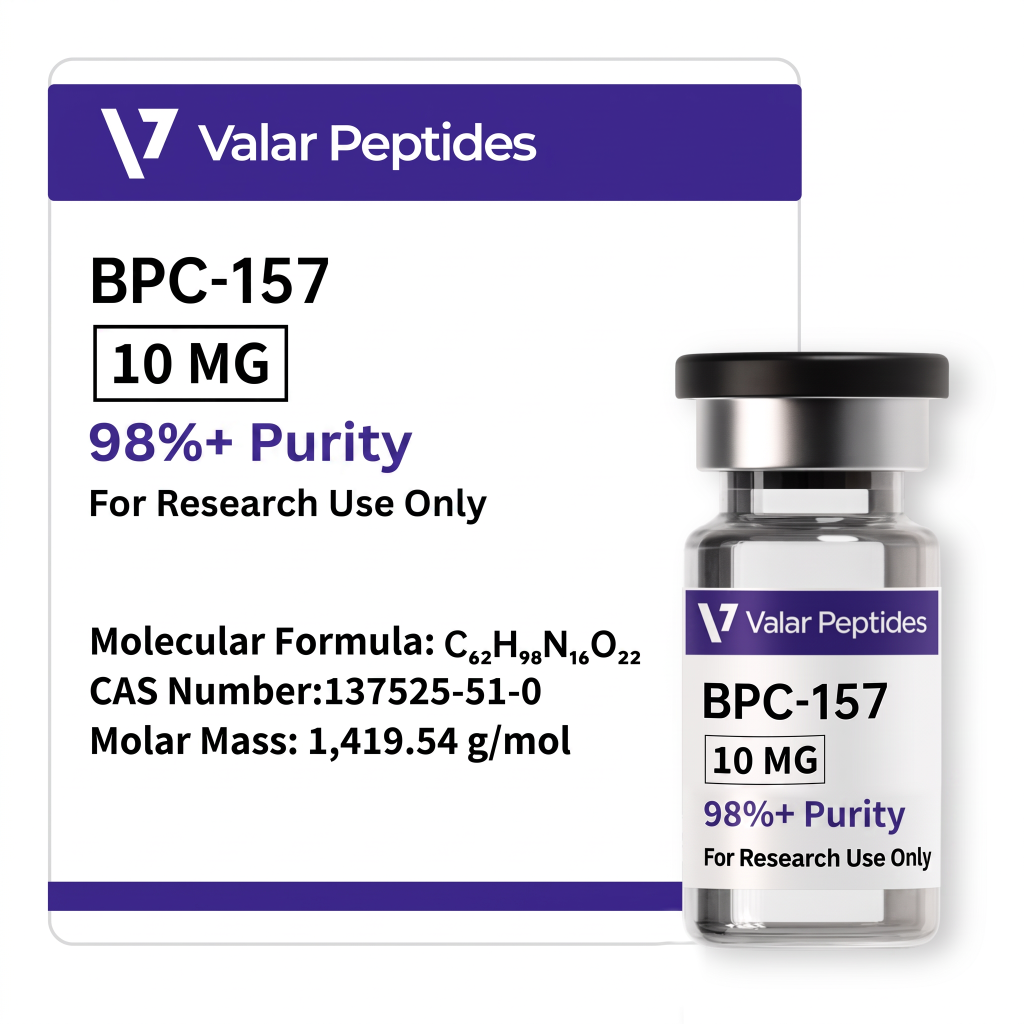
Starting at $38
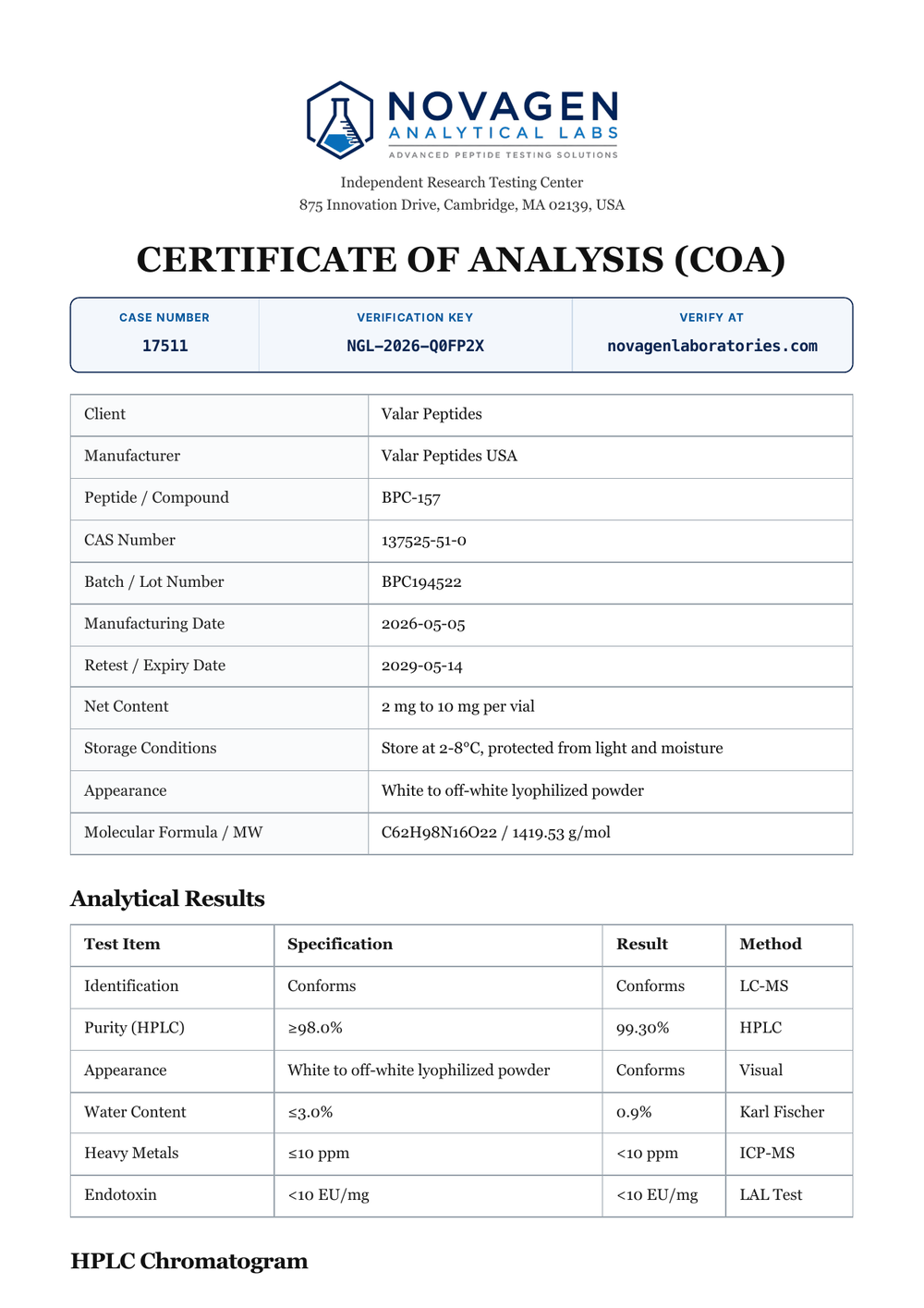
Independently tested by Novagen Analytical Labs
Verify this batch with the lab View the certificate
Every batch we sell carries its own verification key. This one is NGL-2026-Q0FP2X. Enter it on the laboratory's own website and it returns the certificate for this exact batch. That page belongs to the lab, not to us.
BPC-157 (Body Protection Compound 157) is a synthetic pentadecapeptide (15 amino acids) derived from research on naturally occurring gastric peptides. It is recognized for its stability and high resistance to enzymatic degradation, making it a valuable compound for controlled laboratory investigation.
BPC-157 has been widely studied in preclinical models for its potential role in:
Tissue regeneration research (muscle, tendon, and epithelial cells),
Gastrointestinal studies, exploring protective effects on gut lining and gastric integrity,
,Angiogenesis and vascular modulation research,
Neuroprotective and anti-inflammatory investigations
These findings support continued interest in understanding BPC-157’s interaction with cellular growth and repair pathways in experimental contexts.
This order qualifies for free US shipping.
This material is sold for laboratory research use only. Terms of sale apply. Not for human consumption, nor medical, veterinary, or household uses. Please familiarize yourself with our Terms & Conditions prior to ordering.
| Title | Range | Discount |
|---|---|---|
| Volume pricing - 10% at 5+, 20% at 10+ | 5 - 9 | 10% |
| Volume pricing - 10% at 5+, 20% at 10+ | 10 + | 20% |
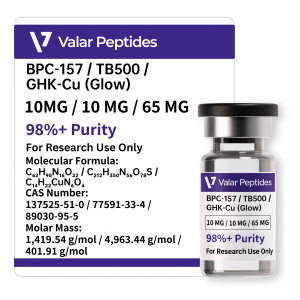
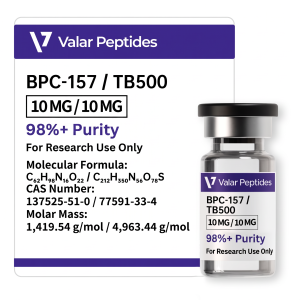
| Molecular Formula | C₆₂H₉₈N₁₆O₂₂ |
| CAS Number | 137525-51-0 |
| Molar Mass | 1419.54 g/mol |
| Amino Acid Sequence | Gly-Glu-Pro-Pro-Pro-Gly-Lys-Pro-Ala-Asp-Asp-Ala-Gly-Leu-Val |
| PubChem CID | 9941957 |
| Primary Research Area |
Cytoprotective, Neuroprotective, Anti-inflammatory Tissue & Organ Healing/Regeneration Inflammatory Bowel Disease Central Nervous System (CNS) Disorders Cancer (Cachexia) Pain Management Alcohol-Induced Adverse Effects Tendon Healing |
| Purity | ≥98% |
| Research Summary | Description |
|---|---|
| Multifunctionality and possible medical application of the BPC 157 peptide—literature and patent review |
Summary: This review article discusses BPC 157's positive effect on general cachexia, a consequence of cancer. Specifically, it notes that BPC 157 (10 μg/mL three times a week i.p.) significantly improved total body weight in the C26 colon adenocarcinoma-induced cancer cachexia mouse model as compared to that of the control group of animals. Tumor volume was lower but not statistically significant. Citation: Kang, H. M., Lee, B. H., Kim, S. J., Kim, S. H., & Kim, Y. S. (2025). Multifunctionality and Possible Medical Application of the BPC 157 Peptide—Literature and Patent Review. Molecules, 18(2), 185. |
| Pentadecapeptide BPC 157 enhances the growth hormone receptor expression in tendon fibroblast |
Summary: This study explored BPC 157's effect on tendon fibroblasts isolated from rat Achilles tendons. It found that BPC 157 dose- and time-dependently increased growth hormone receptor expression at both mRNA and protein levels. Adding growth hormone to BPC 157-treated fibroblasts increased cell proliferation and PCNA expression, activating the Jak2 pathway. Citation: Chang, C. H., Tsai, Y. G., Hsu, Y. H., & Pang, J. H. (2014). Pentadecapeptide BPC 157 Enhances the Growth Hormone Receptor Expression in Tendon Fibroblasts. Molecules, 19(11), 19066–19077. |
| BPC 157: A novel peptide for the treatment of alcohol-induced gastric and liver lesions |
Summary: This early report from 2001 provided evidence that BPC 157 (10 mg and 10 ng/kg b.w. i.p. and i.g.) could prevent, attenuate, and reverse gastric and liver lesions induced by chronic alcohol drinking in rats. Citation: Prkacin, I., Separovic, J., & Sikiric, P. (2001). BPC 157: A novel peptide for the treatment of alcohol-induced gastric and liver lesions. Journal of Physiology-Paris, 95(1-6), 263-268 |
| BPC 157 increases serotonin synthesis in specific brain regions of rats |
Summary: This study reported that subcutaneous administration of BPC 157 (10 μg/kg/day for 7 days) to rats resulted in brain region-specific increases in serotonin synthesis. Citation: Tohyama, Y., Sikiric, P., & Diksic, M. (2004). BPC 157 increases serotonin synthesis in specific brain regions of rats. Journal of Physiology-Paris, 98(4-6), 331-336. |
| Gastric pentadecapeptide body protection compound BPC 157 and its role in accelerating musculoskeletal soft tissue healing |
Summary: This review found consistently positive and prompt healing effects of BPC-157 for soft tissue damage, including tendon, ligament, and skeletal muscle healing. Citation: Sikiric, P. C., Seiwerth, S., Rucman, R., Kolenc, D., Vuletic, L. B., Drmic, I.,... & Vukojevic, J. (2019). Gastric pentadecapeptide body protection compound BPC 157 and its role in accelerating musculoskeletal soft tissue healing. Cell and Tissue Research, 377(2), 153-167. |
| Stable gastric pentadecapeptide BPC 157 and wound healing |
Summary: This review discussed BPC-157's potential in wound healing, including its ability to resolve vessel constriction, primary platelet plug, and fibrin mesh, and its effectiveness in counteracting bleeding disorders and thrombosis. It suggested practical applicability in wound healing, given its ability to simultaneously cure cutaneous and other tissue wounds in rats. Citation: Sikiric, P. C., Seiwerth, S., Rucman, R., Kolenc, D., Vuletic, L. B., Drmic, I.,... & Vukojevic, J. (2021). Stable Gastric Pentadecapeptide BPC 157 and Wound Healing. Frontiers in Pharmacology, 12, 692015. |
Summary: This review article discusses BPC 157's positive effect on general cachexia, a consequence of cancer. Specifically, it notes that BPC 157 (10 μg/mL three times a week i.p.) significantly improved total body weight in the C26 colon adenocarcinoma-induced cancer cachexia mouse model as compared to that of the control group of animals. Tumor volume was lower but not statistically significant.
Citation: Kang, H. M., Lee, B. H., Kim, S. J., Kim, S. H., & Kim, Y. S. (2025). Multifunctionality and Possible Medical Application of the BPC 157 Peptide—Literature and Patent Review. Molecules, 18(2), 185.
Summary: This study explored BPC 157's effect on tendon fibroblasts isolated from rat Achilles tendons. It found that BPC 157 dose- and time-dependently increased growth hormone receptor expression at both mRNA and protein levels. Adding growth hormone to BPC 157-treated fibroblasts increased cell proliferation and PCNA expression, activating the Jak2 pathway.
Citation: Chang, C. H., Tsai, Y. G., Hsu, Y. H., & Pang, J. H. (2014). Pentadecapeptide BPC 157 Enhances the Growth Hormone Receptor Expression in Tendon Fibroblasts. Molecules, 19(11), 19066–19077.
Summary: This early report from 2001 provided evidence that BPC 157 (10 mg and 10 ng/kg b.w. i.p. and i.g.) could prevent, attenuate, and reverse gastric and liver lesions induced by chronic alcohol drinking in rats.
Citation: Prkacin, I., Separovic, J., & Sikiric, P. (2001). BPC 157: A novel peptide for the treatment of alcohol-induced gastric and liver lesions. Journal of Physiology-Paris, 95(1-6), 263-268
Summary: This study reported that subcutaneous administration of BPC 157 (10 μg/kg/day for 7 days) to rats resulted in brain region-specific increases in serotonin synthesis.
Citation: Tohyama, Y., Sikiric, P., & Diksic, M. (2004). BPC 157 increases serotonin synthesis in specific brain regions of rats. Journal of Physiology-Paris, 98(4-6), 331-336.
Summary: This review found consistently positive and prompt healing effects of BPC-157 for soft tissue damage, including tendon, ligament, and skeletal muscle healing.
Citation: Sikiric, P. C., Seiwerth, S., Rucman, R., Kolenc, D., Vuletic, L. B., Drmic, I.,... & Vukojevic, J. (2019). Gastric pentadecapeptide body protection compound BPC 157 and its role in accelerating musculoskeletal soft tissue healing. Cell and Tissue Research, 377(2), 153-167.
Summary: This review discussed BPC-157's potential in wound healing, including its ability to resolve vessel constriction, primary platelet plug, and fibrin mesh, and its effectiveness in counteracting bleeding disorders and thrombosis. It suggested practical applicability in wound healing, given its ability to simultaneously cure cutaneous and other tissue wounds in rats.
Citation: Sikiric, P. C., Seiwerth, S., Rucman, R., Kolenc, D., Vuletic, L. B., Drmic, I.,... & Vukojevic, J. (2021). Stable Gastric Pentadecapeptide BPC 157 and Wound Healing. Frontiers in Pharmacology, 12, 692015.
Your cart is empty
Start Shopping