
Your cart is empty
Start Shopping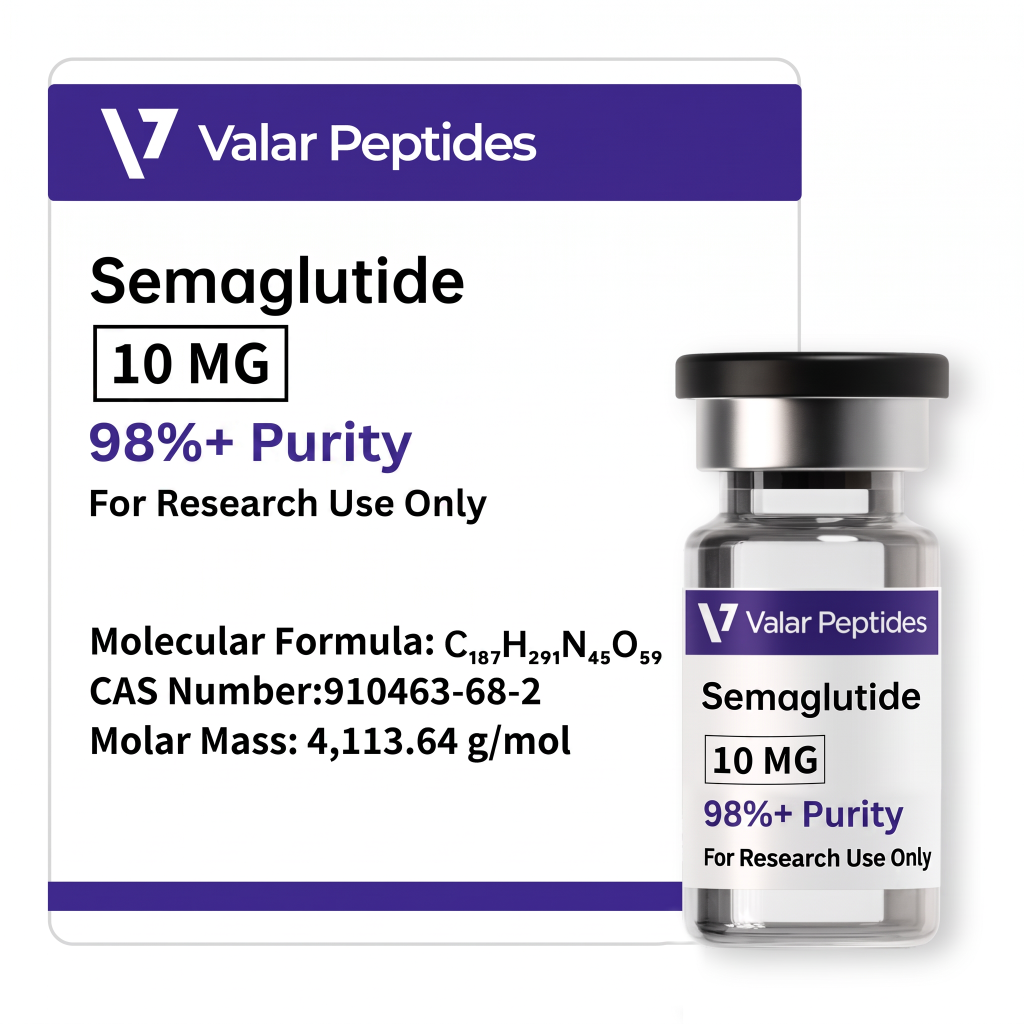
Starting at $51
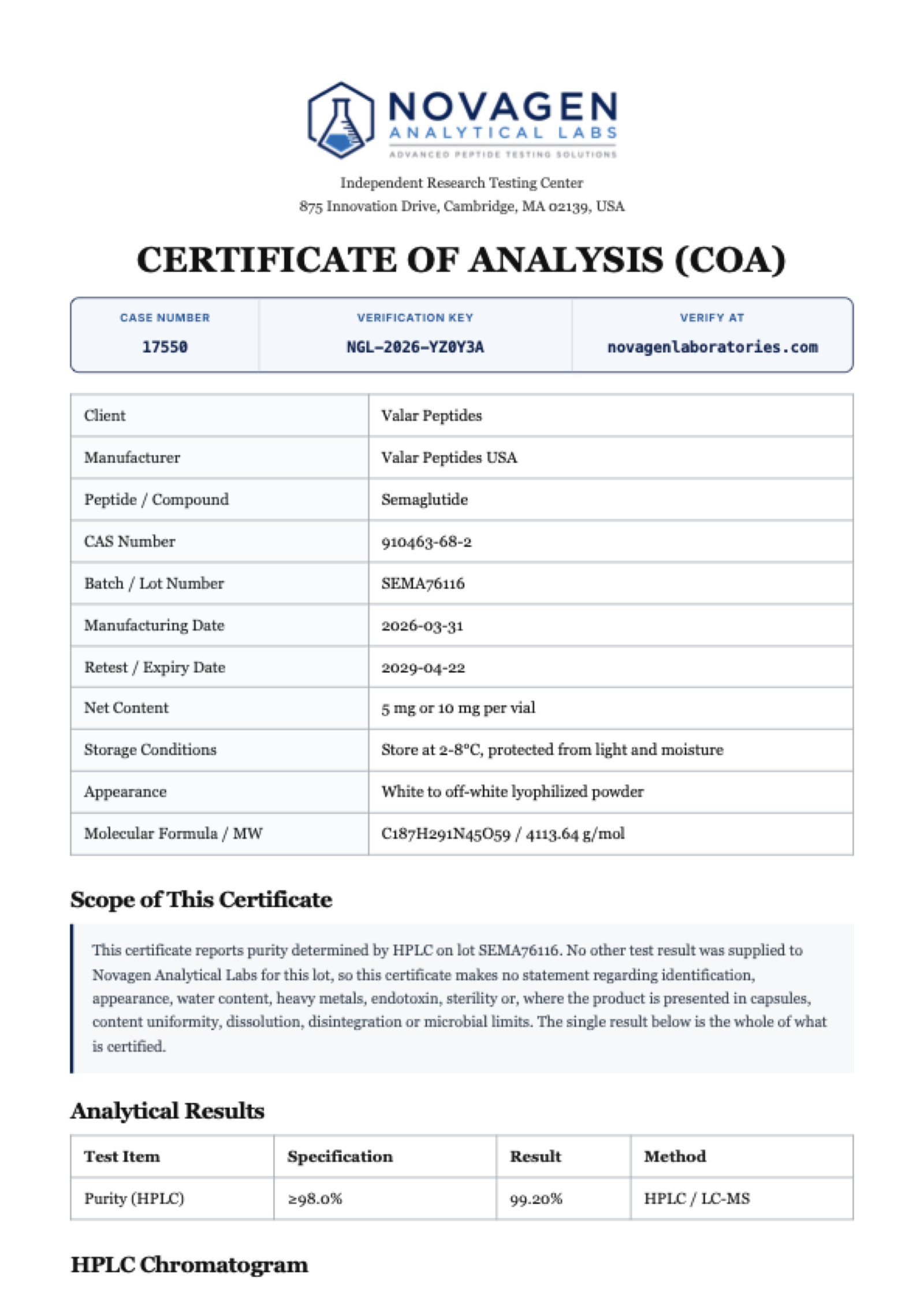
Independently tested by Novagen Analytical Labs
Verify this batch with the lab View the certificate
Every batch we sell carries its own verification key. This one is NGL-2026-YZ0Y3A. Enter it on the laboratory's own website and it returns the certificate for this exact batch. That page belongs to the lab, not to us.
Semaglutide is a high-purity GLP-1 receptor agonist peptide widely used in metabolic and glucose regulation research. With a stabilized molecular structure for extended activity and reliability, it supports studies focused on insulin signaling, appetite control, and energy metabolism. Semaglutide is a synthetic analogue of the glucagon-like peptide-1 (GLP-1) hormone. Its molecular modification enhances resistance to enzymatic degradation, resulting in a longer half-life compared to earlier GLP-1 analogues. In laboratory research, Semaglutide is studied for its potential role in glucose metabolism, pancreatic signaling, and appetite-related pathways, making it a valuable model compound in metabolic studies.
This order qualifies for free US shipping.
This material is sold for laboratory research use only. Terms of sale apply. Not for human consumption, nor medical, veterinary, or household uses. Please familiarize yourself with our Terms & Conditions prior to ordering.
| Title | Range | Discount |
|---|---|---|
| Volume pricing - 10% at 5+, 20% at 10+ | 5 - 9 | 10% |
| Volume pricing - 10% at 5+, 20% at 10+ | 10 + | 20% |
| Molecular Formula | C₁₈₇H₂₉₁N₄₅O₅₉ |
| CAS Number | 910463-68-2 |
| Molar Mass | 4,113.64 g/mol |
| Amino Acid Sequence | H-His-Aib-Glu-Gly-Thr-Phe-Thr-Ser-Asp-Val-Ser-Ser-Tyr-Leu-Glu-Gly-Gln-Ala-Ala-Lys(AEEAc-AEEAc-γ-Glu-17-carboxyheptadecanoyl)-Glu-Phe-Ile-Ala-Trp-Leu-Val-Arg-Gly-Arg-Gly-OH |
| PubChem CID | 56843331 |
| Primary Research Area |
GLP-1 Receptor Agonist Type 2 Diabetes Mellitus (T2DM) Treatment Chronic Weight Management (Overweight/Obesity) Reduction of Major Adverse Cardiovascular Events Slow Gastric Emptying Increase Pancreatic β-cell Proliferation Reduce Glucagon Release Influence Hypothalamic Pathways (Appetite/Satiety) |
| Purity | ≥98% |
| Research Summary | Description |
|---|---|
| Once-weekly semaglutide in adults with overweight or obesity |
Summary: The STEP 1 trial showed a mean weight loss of 14.9% with once-weekly subcutaneous semaglutide 2.4 mg in individuals with overweight or obesity without type 2 diabetes. Citation: Wilding, J. P. H., Batterham, R. L., Calanna, S., Davies, M., Van Gaal, L. F., Lingvay, I.,... & STEP 1 Study Group. (2021). Once-weekly semaglutide in adults with overweight or obesity. New England Journal of Medicine, 384(11), 989-1002. |
| Effect of weekly subcutaneous semaglutide vs daily liraglutide on body weight in adults with overweight or obesity without diabetes: the STEP 8 randomized clinical trial |
Summary: The STEP 8 trial directly compared subcutaneous semaglutide (Wegovy®) to subcutaneous liraglutide for weight loss. Semaglutide proved superior, achieving a mean weight loss of -15.8% compared to -6.4% with liraglutide. Citation: Rubino, D. M., Greenway, F. L., Khalid, U., O'Neil, P. M., Rowe, E., Bartley, D.,... & STEP 8 Investigators. (2022). Effect of weekly subcutaneous semaglutide vs daily liraglutide on body weight in adults with overweight or obesity without diabetes: the STEP 8 randomized clinical trial. JAMA, 327(2), 138-150. |
| Oral Semaglutide and cardiovascular outcomes in high-risk |
Summary: Among persons with type 2 diabetes and atherosclerotic cardiovascular disease, chronic kidney disease, or both, the use of oral semaglutide was associated with a significantly lower risk of major adverse cardiovascular events than placebo, without an increase in the incidence of serious adverse events. Citation: Husain, M., Bain, S. C., Consoli, A., Eliaschewitz, F. G., Jódar, E., Leiter, L. A.,... & PIONEER 6 Investigators. (2019). Oral Semaglutide and Cardiovascular Outcomes in High-Risk. New England Journal of Medicine, 381(9), 842-851. |
| Semaglutide for the treatment of overweight and obesity: A review |
Summary: This review highlights that among patients who persisted with semaglutide for obesity, the average reduction in body weight was -12.9% at one year, compared to -5.9% with semaglutide for type 2 diabetes. Citation: Gasoyan, H., Kim, J., & Kim, Y. (2024). Semaglutide for the treatment of overweight and obesity: A review. Obesity Reviews, 25(10), e13788. |
| Semaglutide 2·4 mg once a week in adults with overweight or obesity, and type 2 diabetes (STEP 2): a randomised, double-blind, double-dummy, placebo-controlled, phase 3 trial |
Summary: In individuals with both overweight/obesity and type 2 diabetes, the STEP 2 trial reported a mean weight loss of -9.6% with semaglutide 2.4 mg and a mean HbA1c reduction of 1.6%. Citation: Davies, M., Færch, L., Jeppesen, O. K., Pakarinen, M., & STEP 2 Study Group. (2021). Semaglutide 2·4 mg once a week in adults with overweight or obesity, and type 2 diabetes (STEP 2): a randomised, double-blind, double-dummy, placebo-controlled, phase 3 trial. The Lancet, 397(10278), 971-984. |
| Semaglutide and cardiovascular outcomes in patients with type 2 diabetes |
Summary: The SUSTAIN 6 trial investigated semaglutide's cardiovascular benefits in patients with T2DM. It demonstrated a reduction in a composite outcome of cardiovascular death, nonfatal myocardial infarction, or nonfatal stroke. Citation: Marso, S. P., Bain, S. C., Consoli, A., Eliaschewitz, F. G., Jódar, E., Leiter, J. A.,... & SUSTAIN 6 Investigators. (2016). Semaglutide and cardiovascular outcomes in patients with type 2 diabetes. New England Journal of Medicine, 375(19), 1834-1844. |
Summary: The STEP 1 trial showed a mean weight loss of 14.9% with once-weekly subcutaneous semaglutide 2.4 mg in individuals with overweight or obesity without type 2 diabetes.
Citation: Wilding, J. P. H., Batterham, R. L., Calanna, S., Davies, M., Van Gaal, L. F., Lingvay, I.,... & STEP 1 Study Group. (2021). Once-weekly semaglutide in adults with overweight or obesity. New England Journal of Medicine, 384(11), 989-1002.
Summary: The STEP 8 trial directly compared subcutaneous semaglutide (Wegovy®) to subcutaneous liraglutide for weight loss. Semaglutide proved superior, achieving a mean weight loss of -15.8% compared to -6.4% with liraglutide.
Citation: Rubino, D. M., Greenway, F. L., Khalid, U., O'Neil, P. M., Rowe, E., Bartley, D.,... & STEP 8 Investigators. (2022). Effect of weekly subcutaneous semaglutide vs daily liraglutide on body weight in adults with overweight or obesity without diabetes: the STEP 8 randomized clinical trial. JAMA, 327(2), 138-150.
Summary: Among persons with type 2 diabetes and atherosclerotic cardiovascular disease, chronic kidney disease, or both, the use of oral semaglutide was associated with a significantly lower risk of major adverse cardiovascular events than placebo, without an increase in the incidence of serious adverse events.
Citation: Husain, M., Bain, S. C., Consoli, A., Eliaschewitz, F. G., Jódar, E., Leiter, L. A.,... & PIONEER 6 Investigators. (2019). Oral Semaglutide and Cardiovascular Outcomes in High-Risk. New England Journal of Medicine, 381(9), 842-851.
Summary: This review highlights that among patients who persisted with semaglutide for obesity, the average reduction in body weight was -12.9% at one year, compared to -5.9% with semaglutide for type 2 diabetes.
Citation: Gasoyan, H., Kim, J., & Kim, Y. (2024). Semaglutide for the treatment of overweight and obesity: A review. Obesity Reviews, 25(10), e13788.
Summary: In individuals with both overweight/obesity and type 2 diabetes, the STEP 2 trial reported a mean weight loss of -9.6% with semaglutide 2.4 mg and a mean HbA1c reduction of 1.6%.
Citation: Davies, M., Færch, L., Jeppesen, O. K., Pakarinen, M., & STEP 2 Study Group. (2021). Semaglutide 2·4 mg once a week in adults with overweight or obesity, and type 2 diabetes (STEP 2): a randomised, double-blind, double-dummy, placebo-controlled, phase 3 trial. The Lancet, 397(10278), 971-984.
Summary: The SUSTAIN 6 trial investigated semaglutide's cardiovascular benefits in patients with T2DM. It demonstrated a reduction in a composite outcome of cardiovascular death, nonfatal myocardial infarction, or nonfatal stroke.
Citation: Marso, S. P., Bain, S. C., Consoli, A., Eliaschewitz, F. G., Jódar, E., Leiter, J. A.,... & SUSTAIN 6 Investigators. (2016). Semaglutide and cardiovascular outcomes in patients with type 2 diabetes. New England Journal of Medicine, 375(19), 1834-1844.
Your cart is empty
Start Shopping