
Your cart is empty
Start Shopping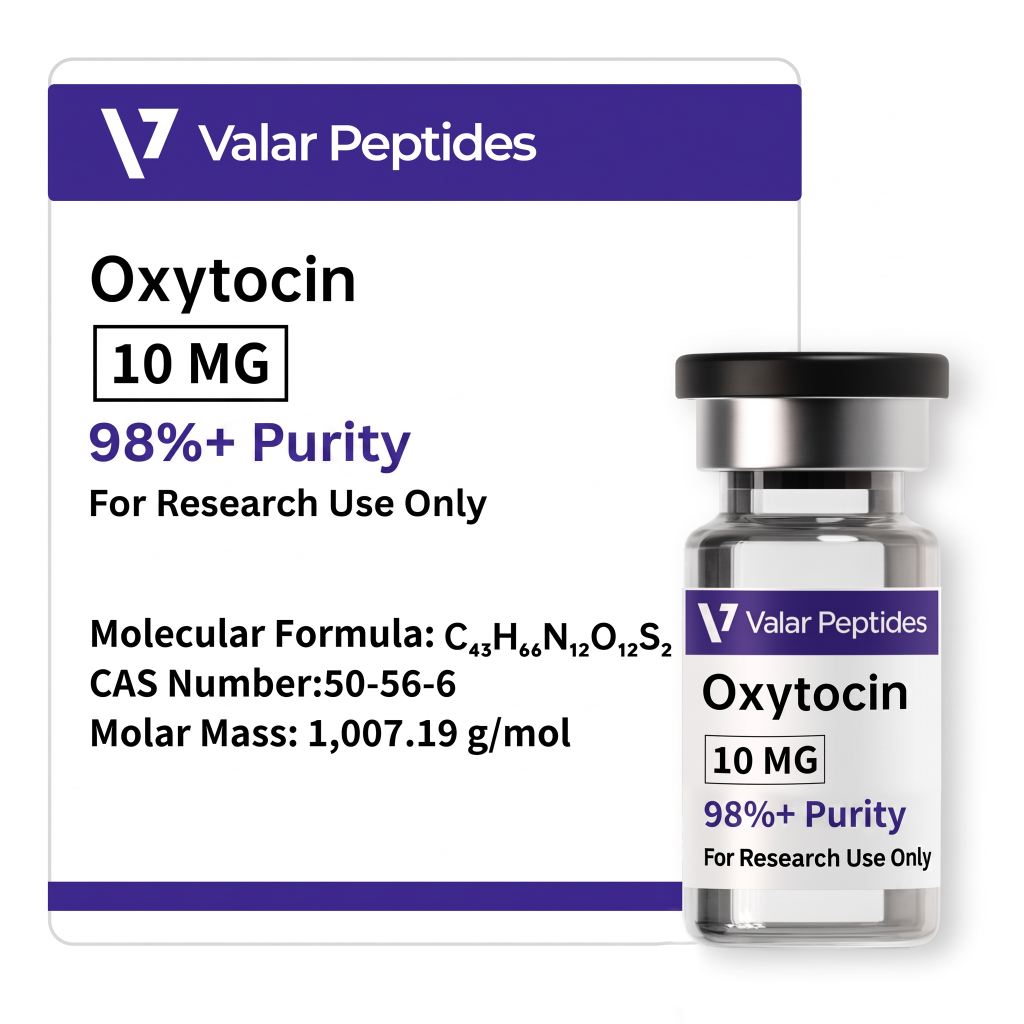
$60
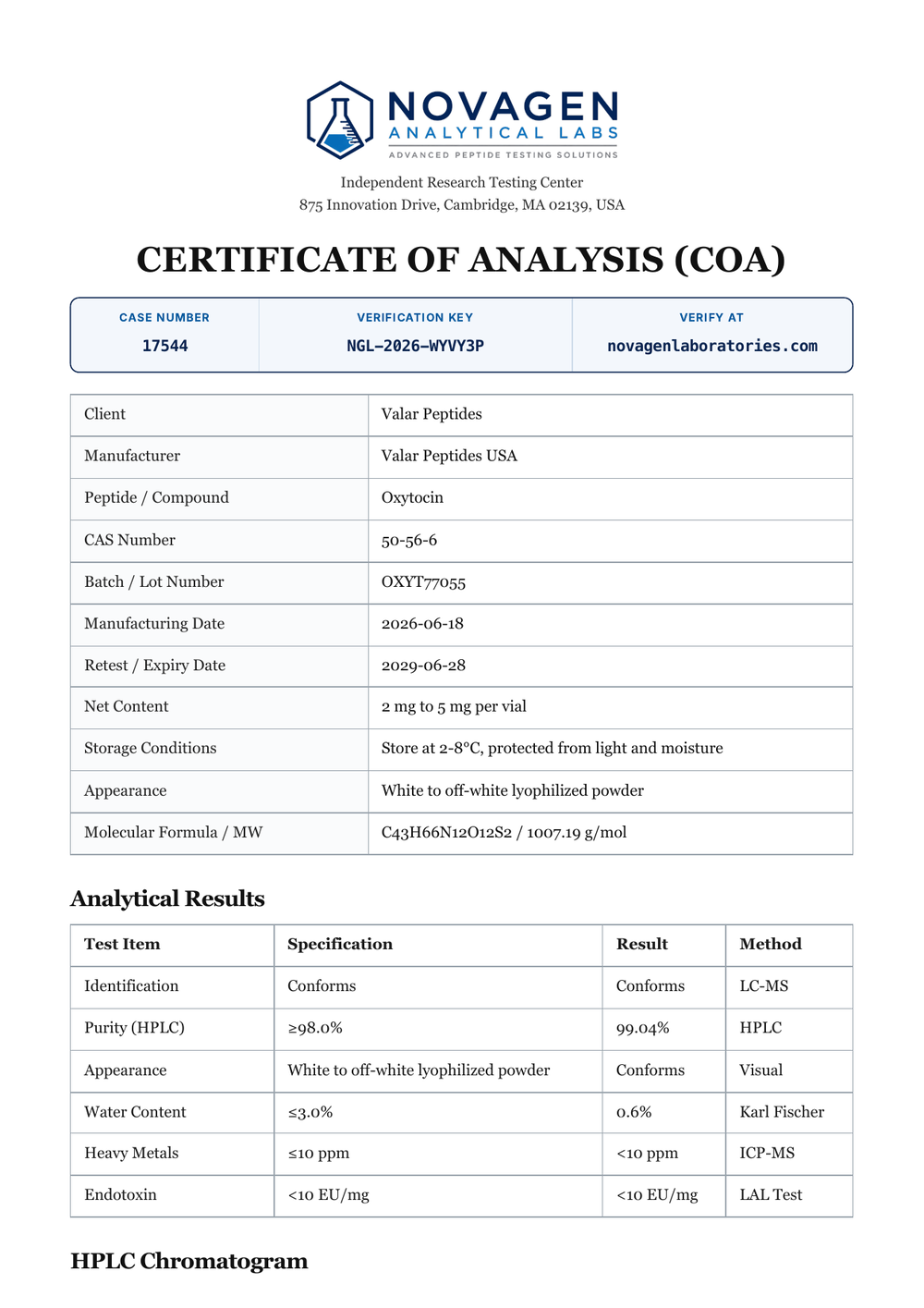
Independently tested by Novagen Analytical Labs
Verify this batch with the lab View the certificate
Every batch we sell carries its own verification key. This one is NGL-2026-WYVY3P. Enter it on the laboratory's own website and it returns the certificate for this exact batch. That page belongs to the lab, not to us.
Oxytocin 10mg is a synthetic peptide hormone identical in structure to the naturally occurring oxytocin produced in the hypothalamus and secreted by the posterior pituitary gland. It has become a key subject in neuroscience and behavioral research due to its diverse physiological and cognitive functions.
Scientific studies have investigated oxytocin’s role in:
Social bonding and affiliative behavior,
Parental and maternal response mechanisms,
Modulation of anxiety and stress pathways,
Pain perception and emotional regulation.
Ongoing research continues to explore how oxytocin influences neural signaling, social cognition, and emotional processing, providing valuable insights into complex neuroendocrine systems.
Each vial is HPLC-tested and MS-verified, ensuring >98% purity and reproducibility for experimental consistency.
Add $140 more for free US shipping.
This material is sold for laboratory research use only. Terms of sale apply. Not for human consumption, nor medical, veterinary, or household uses. Please familiarize yourself with our Terms & Conditions prior to ordering.
| Title | Range | Discount |
|---|---|---|
| Volume pricing - 10% at 5+, 20% at 10+ | 5 - 9 | 10% |
| Volume pricing - 10% at 5+, 20% at 10+ | 10 + | 20% |
| Molecular Formula | C43H66N12O12S2 |
| CAS Number | 50-56-6 |
| Molar Mass | 1007.2 g/mol |
| Amino Acid Sequence | Cys-Tyr-Ile-Gln-Asn-Cys-Pro-Leu-Gly |
| PubChem CID | 439302 |
| Primary Research Area |
Social Bonding Trust Maternal Behavior Childbirth Lactation Reproduction Sexual Behavior Stress Response Anxiety Pain Modulation Autism Spectrum Disorder (ASD) Schizophrenia Empathy Prosocial Behavior Neurodevelopmental Disorders Psychiatric Disorders Neurophysiology Neurotransmitter modulation |
| Purity | ≥98% |
| Research Summary | Description |
|---|---|
| A novel role of oxytocin: Oxytocin-induced well-being in humans |
Summary: This review discusses oxytocin's role beyond its classic functions in reproduction and social bonding, specifically exploring its capacity to induce well-being and pain relief. It describes how oxytocin levels can be increased in the human body through both physical stimulation (e.g., vibration, massage) via somatosensory organs and psychological stimulation (e.g., mindfulness meditation, placebo, positive emotions, fragrance) via visual, olfactory, and auditory sensory organs. The paper proposes a hypothesis that oxytocin contributes to a general sense of well-being and can mitigate pain, highlighting its broader impact on psychological and physiological states. Citation: Uvnäs-Moberg, K., Handlin, L., & Petersson, M. (2019). A novel role of oxytocin: Oxytocin-induced well-being in humans. Frontiers in Neuroscience, 13, 928. |
| Oxytocin and social cognition: a review |
Summary: This comprehensive review synthesizes extensive research on the role of oxytocin in various aspects of human social cognition. It discusses how oxytocin modulates fundamental processes such as trust, empathy, face processing, emotion recognition, and social memory. The review highlights studies showing that exogenous oxytocin administration can enhance prosocial behaviors, increase trust, and improve the processing of social cues. However, it also points out the nuanced effects of oxytocin, which can be context-dependent and influenced by individual differences or pre-existing social environments. Citation: Shamay-Tsoory, S. G., & Abu-Akel, A. (2016). The social-cognitive functions of the oxytocin and vasopressin systems: a review. Biological Psychiatry, 79(3), 199–209. |
| Musculoskeletal pain and brain morphology: Oxytocin's potential as a treatment for chronic pain in aging |
Summary: This review explores the growing evidence for oxytocin's role in pain modulation, particularly in the context of chronic musculoskeletal pain and aging. It discusses how the endogenous oxytocin system, including oxytocin receptor genotype and circulating levels, is associated with variations in brain regions involved in pain processing. The review synthesizes findings that intranasal oxytocin administration can attenuate acute pain. It proposes that given the opioid crisis and the increasing prevalence of chronic pain in older adults, intranasal oxytocin could be a promising alternative therapeutic strategy, suggesting the need for more clinical trials in this area. Citation: Finch, R. A., Borsa, N., Maudsley, S., & Bair, M. J. (2019). Musculoskeletal Pain and Brain Morphology: Oxytocin’s Potential as a Treatment for Chronic Pain in Aging. Frontiers in Aging Neuroscience, 11, 338. |
| Effects of Oxytocin on stress responses, allostasis and resilience |
Summary: This comprehensive review delves into the complex role of oxytocin in modulating stress responses, contributing to allostasis (maintaining stability through change), and fostering resilience. It explains that oxytocin neurons are activated by various stressful stimuli, leading to oxytocin release that modulates neuroendocrine and behavioral stress responses. The review highlights evidence that oxytocin contributes to maintaining homeostasis, helps in adapting to changing environments, and facilitates recovery from stress by inducing active coping mechanisms. It also discusses how early life stress can negatively impact the oxytocin system, leading to long-lasting physiological and behavioral changes. Citation: Cai, Y., Yu, D., & Yang, B. (2022). Effects of Oxytocin on Stress Responses, Allostasis and Resilience. Biomolecules, 12(1), 101. |
Summary: This review discusses oxytocin's role beyond its classic functions in reproduction and social bonding, specifically exploring its capacity to induce well-being and pain relief. It describes how oxytocin levels can be increased in the human body through both physical stimulation (e.g., vibration, massage) via somatosensory organs and psychological stimulation (e.g., mindfulness meditation, placebo, positive emotions, fragrance) via visual, olfactory, and auditory sensory organs. The paper proposes a hypothesis that oxytocin contributes to a general sense of well-being and can mitigate pain, highlighting its broader impact on psychological and physiological states.
Citation:
Uvnäs-Moberg, K., Handlin, L., & Petersson, M. (2019). A novel role of oxytocin: Oxytocin-induced well-being in humans. Frontiers in Neuroscience, 13, 928.
Summary: This comprehensive review synthesizes extensive research on the role of oxytocin in various aspects of human social cognition. It discusses how oxytocin modulates fundamental processes such as trust, empathy, face processing, emotion recognition, and social memory. The review highlights studies showing that exogenous oxytocin administration can enhance prosocial behaviors, increase trust, and improve the processing of social cues. However, it also points out the nuanced effects of oxytocin, which can be context-dependent and influenced by individual differences or pre-existing social environments.
Citation:
Shamay-Tsoory, S. G., & Abu-Akel, A. (2016). The social-cognitive functions of the oxytocin and vasopressin systems: a review. Biological Psychiatry, 79(3), 199–209.
Summary: This review explores the growing evidence for oxytocin's role in pain modulation, particularly in the context of chronic musculoskeletal pain and aging. It discusses how the endogenous oxytocin system, including oxytocin receptor genotype and circulating levels, is associated with variations in brain regions involved in pain processing. The review synthesizes findings that intranasal oxytocin administration can attenuate acute pain. It proposes that given the opioid crisis and the increasing prevalence of chronic pain in older adults, intranasal oxytocin could be a promising alternative therapeutic strategy, suggesting the need for more clinical trials in this area.
Citation:
Finch, R. A., Borsa, N., Maudsley, S., & Bair, M. J. (2019). Musculoskeletal Pain and Brain Morphology: Oxytocin’s Potential as a Treatment for Chronic Pain in Aging. Frontiers in Aging Neuroscience, 11, 338.
Summary: This comprehensive review delves into the complex role of oxytocin in modulating stress responses, contributing to allostasis (maintaining stability through change), and fostering resilience. It explains that oxytocin neurons are activated by various stressful stimuli, leading to oxytocin release that modulates neuroendocrine and behavioral stress responses. The review highlights evidence that oxytocin contributes to maintaining homeostasis, helps in adapting to changing environments, and facilitates recovery from stress by inducing active coping mechanisms. It also discusses how early life stress can negatively impact the oxytocin system, leading to long-lasting physiological and behavioral changes.
Citation:
Cai, Y., Yu, D., & Yang, B. (2022). Effects of Oxytocin on Stress Responses, Allostasis and Resilience. Biomolecules, 12(1), 101.
Your cart is empty
Start Shopping