
Your cart is empty
Start Shopping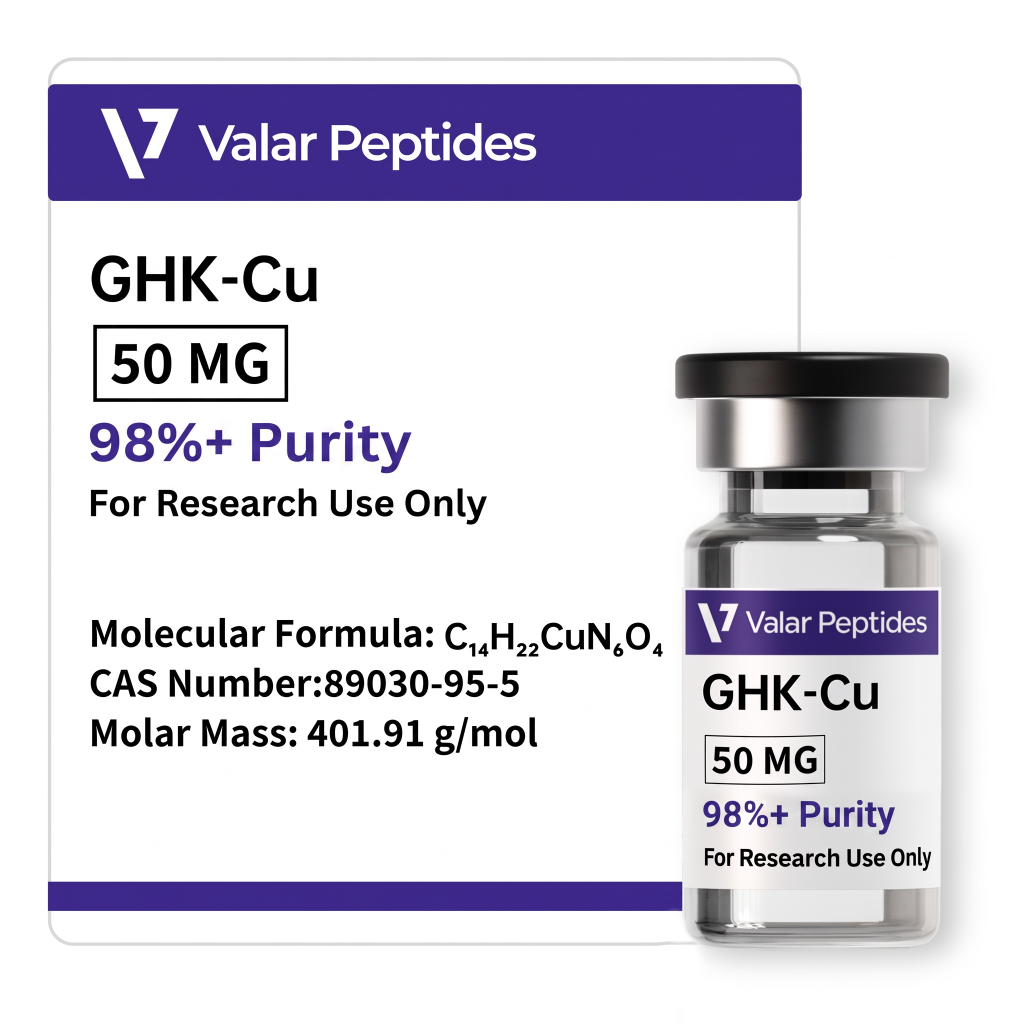
$41
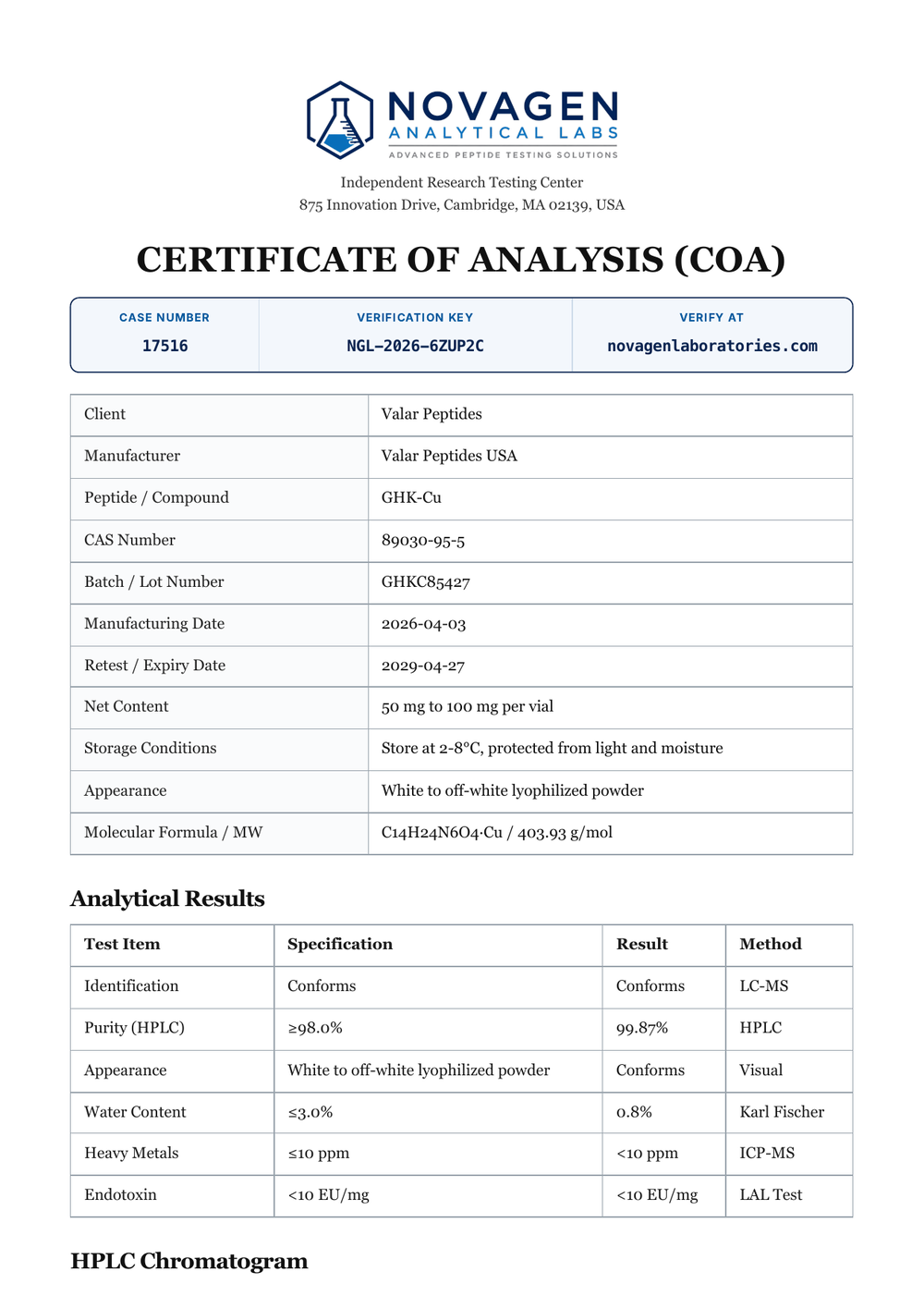
Independently tested by Novagen Analytical Labs
Verify this batch with the lab View the certificate
Every batch we sell carries its own verification key. This one is NGL-2026-6ZUP2C. Enter it on the laboratory's own website and it returns the certificate for this exact batch. That page belongs to the lab, not to us.
GHK-Cu 50mg or Glycyl-L-histidyl-L-lysine-copper is a naturally occurring copper tripeptide complex found in human plasma, saliva, and urine. Known for its strong affinity for copper ions, it plays an essential role in various biochemical and regenerative processes.
In research settings, GHK-Cu has been studied for its potential to:
Support cellular repair and tissue remodeling,
Promote wound healing mechanisms through copper delivery,
Influence gene expression linked to regeneration and protection,
Act as a signaling molecule in cellular communication pathways.
By acting as a copper carrier, GHK-Cu assists in delivering copper to sites where it’s required for enzymatic and cellular functions, making it an important compound in biochemical and regenerative research.
Each batch of GHK-Cu is HPLC-tested and mass spectrometry verified, ensuring >98% purityfor laboratory consistency.
 Choose your quantity
This order qualifies for free US shipping.
This material is sold for laboratory research use only. Terms of sale apply. Not for human consumption, nor medical, veterinary, or household uses. Please familiarize yourself with our Terms & Conditions prior to ordering.
| Title | Range | Discount |
|---|---|---|
| Volume pricing - 10% at 5+, 20% at 10+ | 5 - 9 | 10% |
| Volume pricing - 10% at 5+, 20% at 10+ | 10 + | 20% |
| Molecular Formula | C₁₄H₂₂CuN₆O₄ |
| CAS Number | 89030‑95‑5 |
| Molar Mass | 401.91 g/mol |
| Amino Acid Sequence | Gly-His-Lys |
| PubChem CID | 133697840 |
| Primary Research Area |
Wound Healing & Tissue Remodeling Anti-aging & Tissue-Renewing Antioxidant Properties Anti-inflammatory Properties Skin Regeneration & Cosmetic Applications Chronic Obstructive Pulmonary Disease (COPD) Skin Inflammation Metastatic Colon Cancer Gene Expression Modulation DNA Repair Recover Skin Stem Cells Copper Delivery |
| Purity | ≥98% |
| Research Summary | Description |
|---|---|
| GHK peptide as a natural modulator of multiple cellular pathways in skin regeneration |
Summary: GHK-Cu is well-documented for its ability to accelerate wound healing and improve the success of transplanted skin. Studies have shown that it stimulates both the synthesis and breakdown of collagen and glycosaminoglycans, acting as a key regulator in wound healing and skin remodeling processes. Citation: Pickart, L., & Margolina, A. (2015). GHK Peptide as a Natural Modulator of Multiple Cellular Pathways in Skin Regeneration. BioMed Research International, 2015, 648108. |
| The tri-peptide GHK-Cu complex ameliorates lipopolysaccharide-induced acute lung injury in mice |
Summary: GHK-Cu exhibits potent anti-inflammatory and antioxidant effects. Research by Park et al. (2016) demonstrated that GHK-Cu protected against LPS-induced acute lung injury by inhibiting excessive inflammatory responses, reducing reactive oxygen species (ROS) production, and decreasing pro-inflammatory cytokines like TNF-α and IL-6. Citation: Park, J.-R., Lee, J. H., Kim, S. I., Kim, S. J., Kim, M. S., & Kim, Y. S. (2016). The tri-peptide GHK-Cu complex ameliorates lipopolysaccharide-induced acute lung injury in mice. Journal of Translational Medicine, 14(1), 1-11. |
| Unlocking the secrets of GHK-Cu: the revolutionary peptide for youthful skin and healing |
Summary: This article highlights GHK-Cu's strong antioxidant effects, neutralizing free radicals and reducing oxidative stress, which helps delay signs of aging. It also modulates gene expression to support anti-inflammatory activity and tissue regeneration. Citation: Swolverine. (n.d.). Unlocking the Secrets of GHK-Cu: The Revolutionary Peptide for Youthful Skin and Healing. |
| Regenerative and protective actions of the GHK-Cu peptide in the light of the new gene data |
Summary: This comprehensive review synthesizes decades of research on GHK-Cu. It highlights GHK-Cu's established abilities to tighten loose skin, reverse thinning of aged skin, repair protective skin barrier proteins, improve firmness and elasticity, reduce fine lines and wrinkles, smooth rough skin, reduce photodamage, and stimulate wound healing. Crucially, the review delves into new gene expression data (e.g., from the Broad Institute's Connectivity Map), showing that GHK-Cu can significantly up- and down-regulate thousands of human genes, often reversing gene expression patterns associated with disease or aging. This suggests a deep epigenetic and cellular signaling role for the peptide. Citation: Pickart, L., & Margolina, A. (2018). Regenerative and Protective Actions of the GHK-Cu Peptide in the Light of the New Gene Data. International Journal of Molecular Sciences, 19(7), 1987. https://doi.org/10.3390/ijms19071987 |
| The human tri-peptide GHK and tissue remodeling |
Summary: This foundational paper focuses on GHK (the peptide component without copper) and its role in tissue remodeling. It posits that GHK is an ""emergency response molecule"" released from the extracellular matrix at injury sites. The study discusses how GHK, particularly when complexed with copper, stimulates the synthesis and breakdown of collagen and glycosaminoglycans, and modulates the activity of metalloproteinases (enzymes that break down proteins) and their inhibitors. It emphasizes GHK-Cu's role in attracting immune cells and endothelial cells to injury sites, promoting angiogenesis (new blood vessel formation), and generally accelerating wound healing in various tissues (skin, hair follicles, GI tract, bone). Citation: Pickart, L. (2008). The human tri-peptide GHK and tissue remodeling. Journal of Biomaterials Science, Polymer Edition, 19(8), 969–988. https://doi.org/10.1163/156856208784909435 |
| Exploring the beneficial effects of GHK-Cu on an experimental model of colitis and the underlying mechanisms |
Summary: This recent animal study (in mice) investigated the anti-inflammatory properties of GHK-Cu in a model of dextran sulfate sodium (DSS)-induced colitis, which mimics ulcerative colitis in humans. GHK-Cu treatment significantly alleviated colitis symptoms, including reduced weight loss, lower disease activity index, and improved colon length and macroscopic damage. Histopathological examination showed GHK-Cu reduced mucosal erosion, inflammation (infiltration of immune cells), and goblet cell depletion. Mechanistically, GHK-Cu inhibited the expression of pro-inflammatory cytokines like IL-1$\beta$, IL-6, and TNF- alpha in colonic tissue. Citation: Li, S., Huang, Y., Zhang, R., Li, S., Wang, T., Zhang, K., & Zhou, Y. (2025). Exploring the beneficial effects of GHK-Cu on an experimental model of colitis and the underlying mechanisms. Frontiers in Pharmacology, 15, 1551843. https://doi.org/10.3389/fphar.2025.1551843 |
Summary: GHK-Cu is well-documented for its ability to accelerate wound healing and improve the success of transplanted skin. Studies have shown that it stimulates both the synthesis and breakdown of collagen and glycosaminoglycans, acting as a key regulator in wound healing and skin remodeling processes.
Citation: Pickart, L., & Margolina, A. (2015). GHK Peptide as a Natural Modulator of Multiple Cellular Pathways in Skin Regeneration. BioMed Research International, 2015, 648108.
Summary: GHK-Cu exhibits potent anti-inflammatory and antioxidant effects. Research by Park et al. (2016) demonstrated that GHK-Cu protected against LPS-induced acute lung injury by inhibiting excessive inflammatory responses, reducing reactive oxygen species (ROS) production, and decreasing pro-inflammatory cytokines like TNF-α and IL-6.
Citation: Park, J.-R., Lee, J. H., Kim, S. I., Kim, S. J., Kim, M. S., & Kim, Y. S. (2016). The tri-peptide GHK-Cu complex ameliorates lipopolysaccharide-induced acute lung injury in mice. Journal of Translational Medicine, 14(1), 1-11.
Summary: This article highlights GHK-Cu's strong antioxidant effects, neutralizing free radicals and reducing oxidative stress, which helps delay signs of aging. It also modulates gene expression to support anti-inflammatory activity and tissue regeneration.
Citation: Swolverine. (n.d.). Unlocking the Secrets of GHK-Cu: The Revolutionary Peptide for Youthful Skin and Healing.
Summary: This comprehensive review synthesizes decades of research on GHK-Cu. It highlights GHK-Cu's established abilities to tighten loose skin, reverse thinning of aged skin, repair protective skin barrier proteins, improve firmness and elasticity, reduce fine lines and wrinkles, smooth rough skin, reduce photodamage, and stimulate wound healing. Crucially, the review delves into new gene expression data (e.g., from the Broad Institute's Connectivity Map), showing that GHK-Cu can significantly up- and down-regulate thousands of human genes, often reversing gene expression patterns associated with disease or aging. This suggests a deep epigenetic and cellular signaling role for the peptide.
Citation: Pickart, L., & Margolina, A. (2018). Regenerative and Protective Actions of the GHK-Cu Peptide in the Light of the New Gene Data. International Journal of Molecular Sciences, 19(7), 1987. https://doi.org/10.3390/ijms19071987
Summary: This foundational paper focuses on GHK (the peptide component without copper) and its role in tissue remodeling. It posits that GHK is an ""emergency response molecule"" released from the extracellular matrix at injury sites. The study discusses how GHK, particularly when complexed with copper, stimulates the synthesis and breakdown of collagen and glycosaminoglycans, and modulates the activity of metalloproteinases (enzymes that break down proteins) and their inhibitors. It emphasizes GHK-Cu's role in attracting immune cells and endothelial cells to injury sites, promoting angiogenesis (new blood vessel formation), and generally accelerating wound healing in various tissues (skin, hair follicles, GI tract, bone).
Citation: Pickart, L. (2008). The human tri-peptide GHK and tissue remodeling. Journal of Biomaterials Science, Polymer Edition, 19(8), 969–988. https://doi.org/10.1163/156856208784909435
Summary: This recent animal study (in mice) investigated the anti-inflammatory properties of GHK-Cu in a model of dextran sulfate sodium (DSS)-induced colitis, which mimics ulcerative colitis in humans. GHK-Cu treatment significantly alleviated colitis symptoms, including reduced weight loss, lower disease activity index, and improved colon length and macroscopic damage. Histopathological examination showed GHK-Cu reduced mucosal erosion, inflammation (infiltration of immune cells), and goblet cell depletion. Mechanistically, GHK-Cu inhibited the expression of pro-inflammatory cytokines like IL-1$\beta$, IL-6, and TNF-
alpha in colonic tissue.
Citation: Li, S., Huang, Y., Zhang, R., Li, S., Wang, T., Zhang, K., & Zhou, Y. (2025). Exploring the beneficial effects of GHK-Cu on an experimental model of colitis and the underlying mechanisms. Frontiers in Pharmacology, 15, 1551843. https://doi.org/10.3389/fphar.2025.1551843
Your cart is empty
Start Shopping