
Your cart is empty
Start Shopping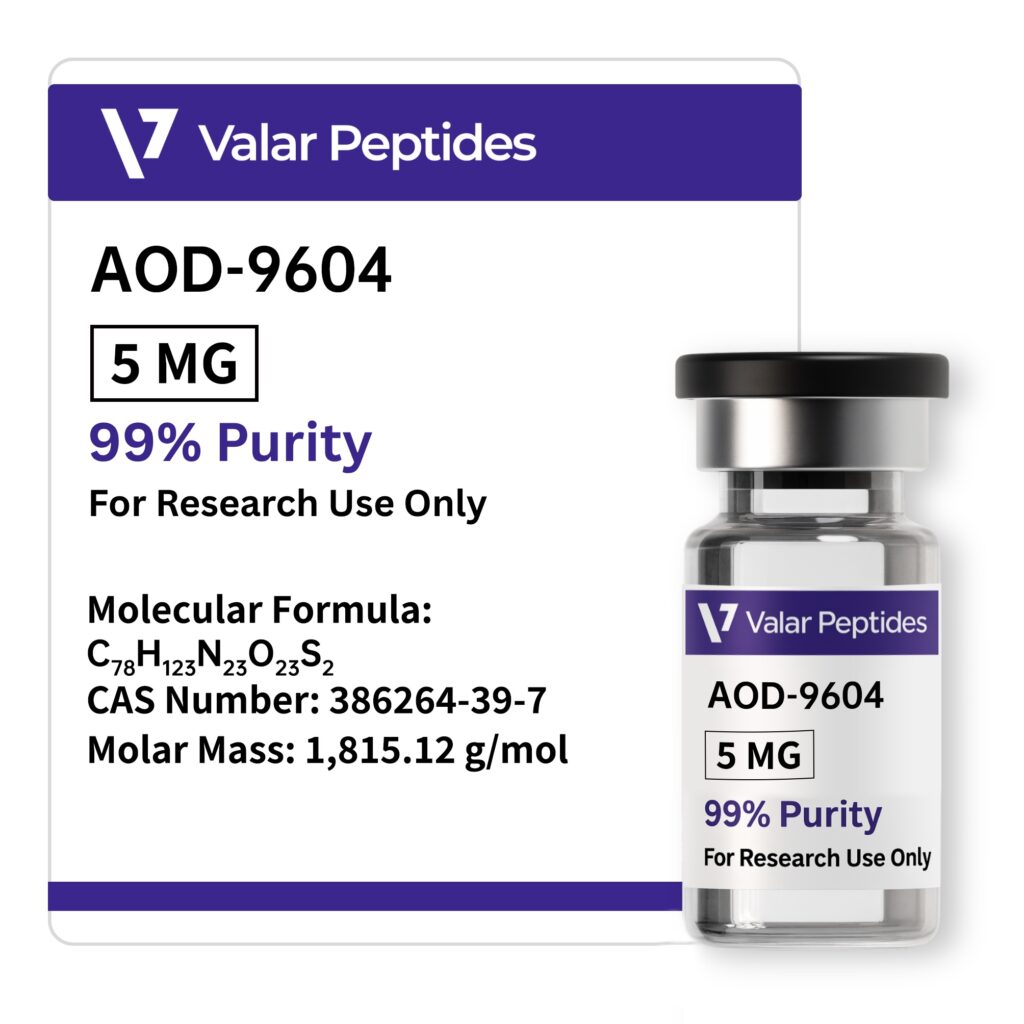
$58.00
This material is sold for laboratory research use only. Terms of sale apply. Not for human consumption, nor medical, veterinary, or household uses. Please familiarize yourself with our Terms & Conditions prior to ordering.
| Title | Range | Discount |
|---|---|---|
| 5 for 5% off | 5 + | 5% |
| Molecular Formula | C₇₈H₁₂₃N₂₃O₂₃S₂ |
| CAS Number | 386264-39-7 |
| Molar Mass | 1,815.12 g/mol |
| Amino Acid Sequence | Tyr-Leu-Arg-Ile-Val-Gln-Cys-Arg-Ser-Val-Glu-Gly-Ser-Cys-Gly-Phe |
| PubChem CID | 71300630 |
| Primary Research Area |
Lipolysis / fat metabolism Weight management / obesity Bone / cartilage / regenerative research Safety & tolerability Cartilage repair, bone metabolism Musculoskeletal regeneration Reflecting its broader relevance in metabolic and regenerative peptide biology |
| Research Summary | Description |
|---|---|
| Safety and tolerability of the hexadecapeptide AOD9604 in humans |
Summary: AOD9604, a peptide fragment of the C-terminus of human growth hormone (hGH), retains the fat-reducing properties of hGH while avoiding its negative effects. Across six randomized, double-blind, placebo-controlled trials, AOD9604 did not alter IGF-1 levels, impair glucose metabolism, or trigger immune responses. No serious adverse events or withdrawals related to the peptide were reported. Implications: AOD9604 appears to be a safe and well-tolerated alternative to full-length hGH for fat reduction, offering potential therapeutic use in obesity management without the risks of IGF-1 elevation, insulin resistance, or other hGH-associated side effects. Its favorable safety profile supports further clinical investigation and potential long-term use. Citation: Stier, H., Vos, E., & Kenley, D. (2013). Safety and Tolerability of the Hexadecapeptide AOD9604 in Humans. Journal of Endocrinology and Metabolism, 3(1-2), 7-15. |
| Metabolic studies of a synthetic lipolytic domain (AOD9604) of human growth hormone |
Summary: In obese Zucker rats, daily oral administration of AOD9604 (500 µg/kg) for 19 days reduced body weight gain by over 50% compared to controls. Treated animals showed increased adipose tissue lipolysis, and unlike full-length hGH, AOD9604 did not impair insulin sensitivity. Implications: AOD9604 demonstrates potential as a safe, orally active anti-obesity therapy, offering targeted fat reduction without the metabolic side effects typically associated with hGH treatment. This supports its further development as a therapeutic agent for obesity management. Citation: Ng, F. M., Sun, J., Sharma, L., Libinaka, R., Jiang, W. J., & Gianello, R. (2000). Metabolic studies of a synthetic lipolytic domain (AOD9604) of human growth hormone. Hormone research, 53(6), 274-278. |
| Can a growth hormone-derived peptide (AOD9604) prevent bone loss and fragility in a rat model of osteoporosis? |
Summary: AOD9604, a synthetic 16-amino-acid C-terminal hGH peptide, was tested in ovariectomized (OVX) rats to assess its effects on bone. Oral administration at 0.25 mg/kg/day and 0.5 mg/kg/day for 12 weeks prevented cortical bone loss and fragility. In trabecular bone, only the lower dose (0.25 mg/kg/day) prevented fragility and attenuated bone loss, while the higher dose (0.5 mg/kg/day) did not show trabecular improvements. Implications: AOD9604 may offer dual benefits for weight management and bone health, particularly in postmenopausal or estrogen-deficient conditions. The dose-dependent effects suggest careful titration is needed to optimize skeletal benefits while minimizing inefficacy at higher doses. Citation: Rowe, E. J. (2007). Can a growth hormone-derived peptide (AOD9604) prevent bone loss and fragility in a rat model of osteoporosis?. |
| Effect of intra-articular injection of AOD9604 with or without hyaluronic acid in rabbit osteoarthritis model |
Summary: In a rabbit model of collagenase-induced knee osteoarthritis, intra-articular injections of AOD9604, with or without hyaluronic acid (HA), were evaluated for cartilage regeneration and lameness. Rabbits receiving combined AOD9604 + HA injections showed significantly improved cartilage morphology, lower histopathological scores, and shorter lameness periods compared to groups receiving either treatment alone or saline. Implications: AOD9604, particularly in combination with HA, may be a promising therapeutic approach for enhancing cartilage repair and reducing joint dysfunction in osteoarthritis. This suggests potential clinical applications for OA treatment and highlights the benefits of combination therapy for joint regeneration. Citation: Kwon, D. R., & Park, G. Y. (2015). Effect of intra-articular injection of AOD9604 with or without hyaluronic acid in rabbit osteoarthritis model. Annals of Clinical & Laboratory Science, 45(4), 426-432. |
| The skeletal effects of a growth hormone-derived peptide (AOD9604) in the aged rat model of postmenopausal osteoporosis |
Summary: In aged ovariectomized (OVX) rats, daily treatment with the GH-derived peptide AOD9604 for 12 weeks increased femoral and vertebral bone mineral density (BMD) and preserved cortical bone strength and stiffness. Trabecular bone mechanical properties were unaffected. Co-treatment with estrogen reduced the bone benefits of AOD9604. Implications: AOD9604 may selectively stimulate cortical bone metabolism, offering potential for preventing postmenopausal osteoporosis without affecting trabecular bone. Its bone-anabolic effects could be beneficial in bone loss conditions, but concurrent estrogen therapy may diminish these effects, suggesting careful consideration in combined treatments. Citation: Fawcett, E. E. (2004). The skeletal effects of a growth hormone-derived peptide (AOD9604) in the aged rat model of postmenopausal osteoporosis. |
| The effect of eight weeks endurance training, somatropin injection, and Its lipolytic fragment (AOD9604) on cytokeratin-18 and liver enzymes of mice induced liver damage due to a high-fat diet |
Summary: This study investigated the effects of endurance training, growth hormone (somatropin), and its lipolytic fragment (AOD9604) on markers of fatty liver in mice. Endurance training alone significantly reduced CK18 levels and HOMA-IR, indicating improved liver function and insulin sensitivity. AOD9604 combined with exercise also improved HOMA-IR, but growth hormone injection increased CK18 levels and did not improve insulin resistance. Liver enzyme changes were minimal, with all treatment groups showing lower alanine transaminase than controls. Implications: Endurance training is more effective than GH or AOD9604 at improving markers of nonalcoholic fatty liver disease (NAFLD). AOD9604 may provide some benefits when combined with exercise, while GH administration could worsen certain liver markers. This suggests lifestyle interventions like exercise may be preferable to pharmacological approaches for NAFLD management, and careful consideration is needed when using GH or peptide therapies in metabolic disorders. Citation: Dehbashi, M., Fathi, M., Attarzadeh Hosseini, S. R., & Mosaferi Ziaaldini, M. (2021). The Effect of Eight Weeks Endurance Training, Somatropin Injection, and Its Lipolytic Fragment (AOD9604) on Cytokeratin-18 and Liver Enzymes of Mice Induced Liver Damage Due to a High-Fat Diet. Internal Medicine Today, 27(4), 502-517. |
| Development of a human growth hormone peptide analogue AOD9604 into an anti-obesity drug |
Summary: Previous research identified that the C-terminal fragment of human growth hormone, hGH(177–191), represents the lipolytic and anti-lipogenic domain of the hormone. By modulating key enzymes in lipid metabolism, this fragment promotes fat breakdown (lipolysis) and reduces fat synthesis (lipogenesis) in adipose tissue, leading to reduced body weight gain in obese rodent models. Building on this potential, the current study focuses on developing hGH(177–191) as a therapeutic agent for human obesity, including the design, synthesis, and structure-activity analysis of peptide analogues. Implications: hGH(177–191) and its analogues offer a promising pharmacological approach to treat obesity by specifically targeting fat metabolism without the broader side effects of full-length hGH. This research supports the potential for safe, targeted anti-obesity peptide therapies and provides a foundation for clinical development in humans. Citation: Jiang, W. J., Gianello, R., Heffernan, M., Ogru, E., Libinaki, R., & Ng, F. (2001). Development of a Human Growth Hormone Peptide Analogue AOD9604 into an Anti-Obesity Drug. In Peptides: The Wave of the Future: Proceedings of the Second International and the Seventeenth American Peptide Symposium, June 9–14, 2001, San Diego, California, USA (pp. 714-715). Dordrecht: Springer Netherlands. |
Summary: AOD9604, a peptide fragment of the C-terminus of human growth hormone (hGH), retains the fat-reducing properties of hGH while avoiding its negative effects. Across six randomized, double-blind, placebo-controlled trials, AOD9604 did not alter IGF-1 levels, impair glucose metabolism, or trigger immune responses. No serious adverse events or withdrawals related to the peptide were reported.
Implications: AOD9604 appears to be a safe and well-tolerated alternative to full-length hGH for fat reduction, offering potential therapeutic use in obesity management without the risks of IGF-1 elevation, insulin resistance, or other hGH-associated side effects. Its favorable safety profile supports further clinical investigation and potential long-term use.
Citation: Stier, H., Vos, E., & Kenley, D. (2013). Safety and Tolerability of the Hexadecapeptide AOD9604 in Humans. Journal of Endocrinology and Metabolism, 3(1-2), 7-15.
Summary: In obese Zucker rats, daily oral administration of AOD9604 (500 µg/kg) for 19 days reduced body weight gain by over 50% compared to controls. Treated animals showed increased adipose tissue lipolysis, and unlike full-length hGH, AOD9604 did not impair insulin sensitivity.
Implications: AOD9604 demonstrates potential as a safe, orally active anti-obesity therapy, offering targeted fat reduction without the metabolic side effects typically associated with hGH treatment. This supports its further development as a therapeutic agent for obesity management.
Citation: Ng, F. M., Sun, J., Sharma, L., Libinaka, R., Jiang, W. J., & Gianello, R. (2000). Metabolic studies of a synthetic lipolytic domain (AOD9604) of human growth hormone. Hormone research, 53(6), 274-278.
Summary: AOD9604, a synthetic 16-amino-acid C-terminal hGH peptide, was tested in ovariectomized (OVX) rats to assess its effects on bone. Oral administration at 0.25 mg/kg/day and 0.5 mg/kg/day for 12 weeks prevented cortical bone loss and fragility. In trabecular bone, only the lower dose (0.25 mg/kg/day) prevented fragility and attenuated bone loss, while the higher dose (0.5 mg/kg/day) did not show trabecular improvements.
Implications: AOD9604 may offer dual benefits for weight management and bone health, particularly in postmenopausal or estrogen-deficient conditions. The dose-dependent effects suggest careful titration is needed to optimize skeletal benefits while minimizing inefficacy at higher doses.
Citation: Rowe, E. J. (2007). Can a growth hormone-derived peptide (AOD9604) prevent bone loss and fragility in a rat model of osteoporosis?.
Summary: In a rabbit model of collagenase-induced knee osteoarthritis, intra-articular injections of AOD9604, with or without hyaluronic acid (HA), were evaluated for cartilage regeneration and lameness. Rabbits receiving combined AOD9604 + HA injections showed significantly improved cartilage morphology, lower histopathological scores, and shorter lameness periods compared to groups receiving either treatment alone or saline.
Implications: AOD9604, particularly in combination with HA, may be a promising therapeutic approach for enhancing cartilage repair and reducing joint dysfunction in osteoarthritis. This suggests potential clinical applications for OA treatment and highlights the benefits of combination therapy for joint regeneration.
Citation: Kwon, D. R., & Park, G. Y. (2015). Effect of intra-articular injection of AOD9604 with or without hyaluronic acid in rabbit osteoarthritis model. Annals of Clinical & Laboratory Science, 45(4), 426-432.
Summary: In aged ovariectomized (OVX) rats, daily treatment with the GH-derived peptide AOD9604 for 12 weeks increased femoral and vertebral bone mineral density (BMD) and preserved cortical bone strength and stiffness. Trabecular bone mechanical properties were unaffected. Co-treatment with estrogen reduced the bone benefits of AOD9604.
Implications: AOD9604 may selectively stimulate cortical bone metabolism, offering potential for preventing postmenopausal osteoporosis without affecting trabecular bone. Its bone-anabolic effects could be beneficial in bone loss conditions, but concurrent estrogen therapy may diminish these effects, suggesting careful consideration in combined treatments.
Citation: Fawcett, E. E. (2004). The skeletal effects of a growth hormone-derived peptide (AOD9604) in the aged rat model of postmenopausal osteoporosis.
Summary: This study investigated the effects of endurance training, growth hormone (somatropin), and its lipolytic fragment (AOD9604) on markers of fatty liver in mice. Endurance training alone significantly reduced CK18 levels and HOMA-IR, indicating improved liver function and insulin sensitivity. AOD9604 combined with exercise also improved HOMA-IR, but growth hormone injection increased CK18 levels and did not improve insulin resistance. Liver enzyme changes were minimal, with all treatment groups showing lower alanine transaminase than controls.
Implications: Endurance training is more effective than GH or AOD9604 at improving markers of nonalcoholic fatty liver disease (NAFLD). AOD9604 may provide some benefits when combined with exercise, while GH administration could worsen certain liver markers. This suggests lifestyle interventions like exercise may be preferable to pharmacological approaches for NAFLD management, and careful consideration is needed when using GH or peptide therapies in metabolic disorders.
Citation: Dehbashi, M., Fathi, M., Attarzadeh Hosseini, S. R., & Mosaferi Ziaaldini, M. (2021). The Effect of Eight Weeks Endurance Training, Somatropin Injection, and Its Lipolytic Fragment (AOD9604) on Cytokeratin-18 and Liver Enzymes of Mice Induced Liver Damage Due to a High-Fat Diet. Internal Medicine Today, 27(4), 502-517.
Summary: Previous research identified that the C-terminal fragment of human growth hormone, hGH(177–191), represents the lipolytic and anti-lipogenic domain of the hormone. By modulating key enzymes in lipid metabolism, this fragment promotes fat breakdown (lipolysis) and reduces fat synthesis (lipogenesis) in adipose tissue, leading to reduced body weight gain in obese rodent models. Building on this potential, the current study focuses on developing hGH(177–191) as a therapeutic agent for human obesity, including the design, synthesis, and structure-activity analysis of peptide analogues.
Implications: hGH(177–191) and its analogues offer a promising pharmacological approach to treat obesity by specifically targeting fat metabolism without the broader side effects of full-length hGH. This research supports the potential for safe, targeted anti-obesity peptide therapies and provides a foundation for clinical development in humans.
Citation: Jiang, W. J., Gianello, R., Heffernan, M., Ogru, E., Libinaki, R., & Ng, F. (2001). Development of a Human Growth Hormone Peptide Analogue AOD9604 into an Anti-Obesity Drug. In Peptides: The Wave of the Future: Proceedings of the Second International and the Seventeenth American Peptide Symposium, June 9–14, 2001, San Diego, California, USA (pp. 714-715). Dordrecht: Springer Netherlands.
Your cart is empty
Start Shopping